
Picture a pouch line near the end of a busy shift. A date coder starts printing faint characters, but the packs keep moving. Operators catch the problem later, leaving quality staff to identify the affected batch and decide what needs inspection or rework.
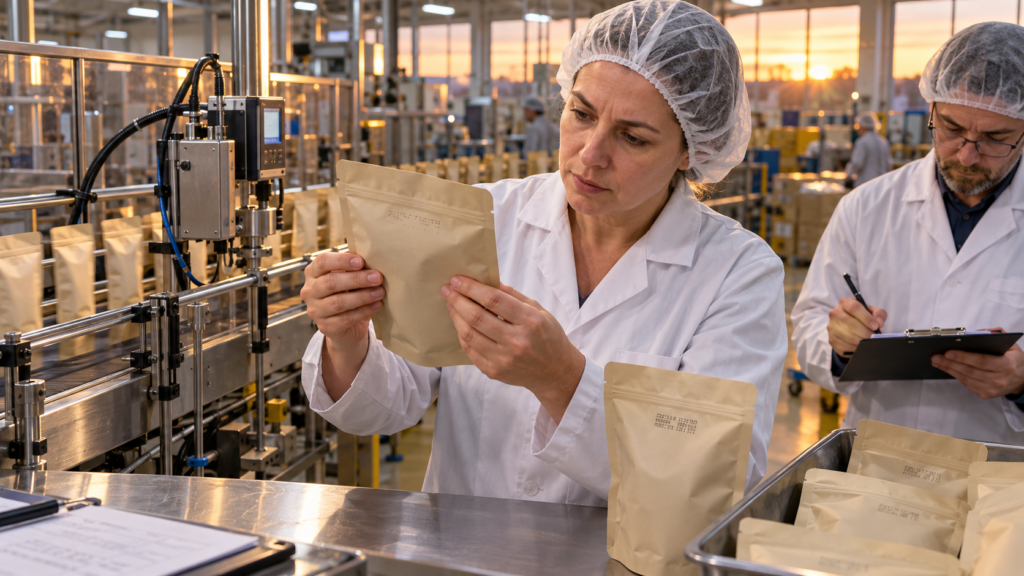
Learning how to enable AI in the packaging industry starts with that operational problem. A useful system must detect the issue, identify the affected pack, trigger the right response, and preserve evidence for quality review. For related industrial applications, see our guide to AI for machines and hardware.
This guide explains how to plan that system: where to begin, how to connect existing equipment, which technologies to consider, and how to prove that a pilot works under production conditions. The opening scenario is illustrative; the named company examples later in the guide are attributed to official sources.
Quick answer: How to enable AI in the packaging industry starts with choosing a measurable production problem, collecting representative data, and connecting an appropriate model to existing workflows. Validate performance in shadow mode, approve controlled actions, train operators, and monitor quality, downtime, material use, and ongoing costs before scaling across lines.
What AI enablement means for packaging
To understand how to enable AI in the packaging industry, think of a trained model supported by reliable data, equipment connections, people, and operating controls.
For a packaging converter, that might mean using print defect detection to identify inconsistent output from a flexographic printing press. For a contract packer, it might mean verifying batch codes on finished cartons. For a fulfillment business, it could mean recommending a protective shipping package with less unused space.
These applications share a simple structure:
- Capture a reliable signal, such as an image, vibration reading, or order record.
- Add context, including product, machine state, and approved specification.
- Use a model to classify, predict, or recommend.
- Route the result into an approved action.
- Measure the outcome and maintain the system.
The action matters. A defect score on a dashboard creates little value if nobody can identify or contain the affected product.
AI also differs from ordinary automation. A photoelectric sensor can detect a missing pack without machine learning. A deterministic vision tool may check a fixed dimension more simply than an AI model. Use AI when learning from examples helps solve a demonstrated limitation. Similar decisions arise in AI-enabled electronics manufacturing, where inspection systems must also fit real production workflows.
Key Takeaway: Define AI enablement as a working decision process. For example, “flag faint date codes and hold affected packs for review” is a useful scope; “make the line intelligent” is too vague to implement.
Why enable AI and when to start
Packaging operations deal with variation: reflective films, changing artwork, different suppliers, frequent changeovers, fluctuating demand, and machines running under different loads. Those variations can make fixed inspection rules or simple alarm thresholds difficult to maintain.
Artificial intelligence in packaging can help when there is a repeated decision that depends on patterns in that variation. Computer vision can recognize certain visual defects; predictive analytics can highlight unusual machine behavior; forecasting can support production planning.
The cost of leaving a known problem unresolved may include scrap, rework, customer complaints, downtime, or avoidable inspection effort. Measure that cost before using it to justify a purchase.
When deciding how to enable AI in the packaging industry, start only when three conditions are present:
- A specific loss is important enough to address.
- Suitable data can be collected and checked.
- Someone owns the response to the model’s output.
For example, recurring conveyor stoppages may justify conveyor anomaly detection if the plant can capture operating signals and maintenance can act on useful alerts. If breakdown records are inconsistent and no one can investigate alarms, improve those foundations first.
Expert Tip: Compare the proposed AI project with a simpler repair, sensor, process adjustment, or rules-based inspection. Choose the approach that solves the problem with an acceptable operating burden.
Benefits and success measures
Benefits should describe changes in production outcomes. “We installed three cameras” measures deployment activity, while “we reduced confirmed incorrect-code escapes without increasing false rejects” measures operational value.
| Desired benefit | What to measure | Example application | Important qualification |
|---|---|---|---|
| More consistent quality inspection | Defect recall and false reject rate | Detect visible printing defects | Test each important defect class |
| Less unplanned downtime | Useful warning time, nuisance alerts, and downtime | Sealer condition monitoring | An alert needs an effective maintenance response |
| Lower material consumption | Material consumed per acceptable shipped unit | Packaging lightweighting or right-sizing | Include damage and returns |
| Higher first-pass yield | Units accepted without rework / units entering the process | Earlier identification of label errors | Keep the measurement definition stable |
| More usable production capacity | OEE and sellable output | Packaging line optimization | Extra capacity matters financially when demand or avoided cost supports it |
| Faster document retrieval | Correct answers, source references, and time saved | Packaging SOP assistant | Evaluate revision accuracy and uncertain answers |
| Better production planning | Forecast error, bias, service level, and inventory | Packaging demand forecasting | Compare with the existing planning method |
Overall equipment effectiveness, or OEE, combines availability, performance, and quality. AI can influence one or more components, but improved OEE should not be claimed from a model accuracy score alone.
For example, an inspection upgrade might catch more defects while producing more unnecessary rejects. The business needs both measures to decide whether the upgrade is useful.
Best Practice: Agree on the baseline, denominator, measurement period, and acceptance criteria before a supplier trial. Otherwise, before-and-after comparisons can become misleading.
Where AI can be implemented
Choosing how to enable AI in the packaging industry depends on whether the business makes packaging materials, fills packages, or ships products. A corrugated-board producer has different opportunities from a beverage bottling plant.
| Process | Practical AI use case | Required inputs | Decision or action |
|---|---|---|---|
| Printing and converting | Print defect detection on labels, cartons, or flexible film | Controlled images, approved reference, defect labels | Flag affected output for disposition |
| Corrugated production | Corrugated board quality prediction | Process settings, material properties, test outcomes | Recommend investigation or an engineering trial |
| Filling and closing | Filler performance monitoring or cap presence detection | Sensor readings, images, speed, product context | Alert, inspect, or reject under approved logic |
| Form-fill-seal operations | Visible seal contamination or wrinkle detection | Seal images and quality decisions | Route suspect packs for review or rejection |
| Coding and labeling | Packaging OCR inspection and label verification | Images plus expected date, lot, and SKU | Compare observed content with approved values |
| Maintenance | Time series anomaly detection | Vibration, current, temperature, load, work history | Investigate and create an appropriate work order |
| Fulfillment | Packaging damage prediction and package selection | Dimensions, product properties, packaging options, delivery outcomes | Recommend a package within protection constraints |
| Planning | Demand and production forecasting | Orders, history, capacity, lead times | Support planner decisions |
| Technical support | Retrieval from approved machine manuals | Current documents, permissions, document references | Provide grounded guidance or escalate |
Match the inspection to the physical defect
Seal appearance inspection can detect some visible problems, such as contamination in a visible seal area. It cannot establish every aspect of package integrity. Keep validated leak, peel, burst, or other relevant tests for failure modes that a camera cannot observe.
Likewise, a barcode reader decoding a symbol does not establish that the barcode belongs on that product. Standards-based print verification is another task: GS1 member guidance distinguishes verification methods for linear and two-dimensional symbols under ISO/IEC 15416 and ISO/IEC 15415. GS1 barcode verification
For example, a carton may have a clearly readable code containing the wrong product identifier. The system needs expected product data as well as a readable image.
Warning: Define what each measurement can prove. AI vision, checkweighers, barcode verifiers, X-ray systems, and seal-integrity equipment can complement one another, but their outputs are not interchangeable.
How to Enable AI in the Packaging Industry Step by Step
Use a bounded pilot to establish technical performance, operator acceptance, and business value. The following schedule is an illustrative plan for a retrofit inspection project with available data and engineering resources. It is not an industry-average implementation promise.
| Phase | Planning range | Main work | Gate before progressing |
|---|---|---|---|
| Define the loss | Weeks 1–2 | Establish baseline and choose the decision | Business owner agrees scope and success measures |
| Check feasibility | Weeks 2–4 | Inspect data, capture conditions, and machine interfaces | Quality and engineering accept the test plan |
| Build and test offline | Weeks 4–7 | Configure or train; evaluate independent production examples | Important error types are understood |
| Run in shadow mode | Weeks 7–10 | Observe live operation without production authority | Live performance and workload meet agreed criteria |
| Release controlled operation | Weeks 10–12 | Test physical actions, fallback, and operator procedures | Quality and OT approve release |
| Stabilize and scale | Following 1–3 months | Confirm sustained value and repeatable support | Finance and operations approve expansion |
Procurement delays, rare defects, inaccessible interfaces, or formal validation obligations can extend this schedule. Predictive maintenance may need much longer observation to assess infrequent failures.
Step 1 Choose one measurable loss
Write a short project charter covering the problem, affected equipment, baseline, intended action, owner, and release criteria.
For a date-code project, the charter might say: “Inspect printed codes at the outlet of this pouch line, compare them with the active approved batch information, and route unreadable or incorrect codes into the site’s quality disposition process.”
Compare candidate projects by business value, data readiness, integration effort, validation difficulty, and operating ownership. Treat unacceptable safety or compliance risk as a separate stop condition.
Step 2 Audit existing equipment and data
Check the machine’s programmable logic controller, or PLC, supported interfaces, spare inputs/outputs, available mounting positions, production tracking, and maintenance constraints.
Ask whether the current manufacturing execution system (MES), enterprise resource planning system (ERP), or quality management system (QMS) contains reliable SKU and batch information. A stock keeping unit, or SKU, identifies a product variant; the AI station needs to know which variant it is inspecting.
For an older line, a smart camera and supported PLC connection may be feasible without replacing the machine. Confirm that with the OEM or a competent integrator before ordering equipment.
Step 3 Collect representative data
Collect examples across actual production runs, suppliers, shifts, speeds, packaging materials, and acceptable appearance variation. Quality staff should define defect classes and adjudicate ambiguous samples.
Keep training data separate from evaluation data. Splitting similar frames from the same pack across both sets can make performance look better than it is. Where appropriate, hold out entire runs or later time periods.
For reflective pouches, include realistic glare and material variation. If a defect cannot be seen consistently in the captured image, improve acquisition before training.
Step 4 Choose a deployment approach
Choose between an existing deterministic tool, packaged AI inspection, a custom model, or an integrator-led hybrid. Include the effort required to operate and maintain the solution after commissioning.
A contract packer with limited ML staff may prefer a supported industrial vision system. Our electronics industry AI implementation guide discusses comparable factory integration choices. A large converter with specialized multi-camera requirements may justify a custom vision pipeline.
Step 5 Test offline against agreed criteria
Measure missed defects and false rejects by defect type and operating condition. Investigate failures rather than tuning only for an overall accuracy number.
For example, performance on clear printed codes should not hide poor results on faint codes. Quality must decide whether the latter failure mode is acceptable.
Step 6 Run in shadow mode
Shadow mode allows the model to observe live production and record proposed decisions without taking over the production action. Compare its decisions with independent quality checks and investigate disagreements.
Run the system during changeovers and unusual conditions as well as stable production. Capture operator review effort: a technically accurate system that creates an unmanageable queue may still fail operationally.
Step 7 Validate actions and release carefully
Test package tracking, reject timing, reject confirmation, full reject bins, camera faults, lost network connections, stale recipes, and restart behavior.
Quality and operational technology (OT) staff should approve the control scope. Define whether a fault requires a hold, a stop, manual inspection, or another site-approved response.
Step 8 Assign ownership and scale on evidence
Name the person who monitors performance, the team that handles incidents, and the authority that approves changes. Review sustained benefits before copying the setup to another line.
For example, a model validated on matte film should not be released automatically on metallized film. Similar packaging can create very different images.
Common Mistake: Treating a successful demonstration as production validation. A useful pilot must prove data capture, the model, physical actions, fallback, and ongoing support together.
AI technologies used in packaging
Selecting how to enable AI in the packaging industry begins with the signal available and the decision required. “AI packaging solutions” can refer to very different systems.
| Technology | What it does | Packaging example | Main limitation |
|---|---|---|---|
| Image classification | Assigns an image to a category | Acceptable versus visibly damaged carton | May not locate the defect |
| Object detection | Finds and classifies objects or regions | Missing cap or misplaced label | Needs suitable visibility and representative examples |
| Image segmentation | Marks relevant pixels or regions | Localize a print defect on film | Labeling and validation can be demanding |
| Optical character recognition (OCR) | Reads characters from images | Date code verification | Read text must still be compared with expected content |
| Visual anomaly detection | Finds deviations from learned appearance | Unusual surface or assembly condition | Acceptable variation can trigger false alarms |
| Time-series models | Learn patterns over time | Sealer condition monitoring | Operating-state changes can resemble faults |
| Forecasting and predictive ML | Predicts quantities or outcomes | Demand or damage-risk prediction | Results depend on data quality and changing conditions |
| Constrained optimization | Recommends choices within limits | Material or setting selection | Constraints and physical tests must reflect reality |
| LLMs with retrieval | Answers using retrieved documents | Approved-machine-manual assistant | Can still misinterpret evidence or answer incorrectly |
Retrieval augmented generation (RAG) supplies relevant documents to a large language model. For packaging support, that means retrieving the correct approved manual revision before generating an answer. Permission checks and escalation remain necessary.
A digital twin models aspects of a production system. It can support simulation and engineering decisions, but building one is not a prerequisite for a first inspection pilot.
Pro Tip: Write the required output before choosing the model. “Read these characters and compare them with the active lot record” is more precise than “use computer vision.”
AI tools to shortlist for packaging projects
The best AI tools for a packaging plant are the ones that fit its use case, interfaces, engineering capacity, and support requirements. The following shortlist comes from official product documentation; it is not a hands-on ranking or pricing comparison.
| Tool | Purpose | Advantages | Limitations | Ideal use case |
|---|---|---|---|---|
| Cognex In-Sight AI-capable systems | Industrial vision, inspection, and OCR | Industrial hardware with AI inspection options | Capabilities depend on model and licensing; optics and validation still matter | Station-level packaging inspection |
| Siemens Inspekto | Visual anomaly and presence inspection | Packaged approach with simplified commissioning | Fast setup does not establish performance on every defect | A bounded retrofit visual-quality project |
| NVIDIA DeepStream SDK | Custom image/video inference pipelines | Flexible foundation for developer-built vision applications | Requires compatible hardware, engineering, and lifecycle support | Specialized or multi-camera inspection |
| Azure Machine Learning | Develop, deploy, and monitor models | Supports managed model lifecycle workflows | Requires ML/data skills and deployment design | Custom analytics across multiple use cases |
| Amazon SageMaker AI | Train and deploy custom ML models | Managed model-development and hosting components | Check current feature eligibility and regional availability | Custom quality or packaging damage models |
| AWS IoT SiteWise anomaly detection | Industrial asset data and anomaly monitoring | Connects equipment context with anomaly detection | Requires suitable signals and a maintenance response | Connected packaging equipment monitoring |
| IBM Maximo Application Suite | Asset, maintenance, inspection, and reliability management | Links analytics with work management | Broader implementation scope; depends on asset and work-order quality | Plants improving maintenance processes alongside analytics |
Sources: Cognex, Siemens, NVIDIA, Microsoft, AWS SageMaker, AWS SiteWise alternative guidance, and IBM.
Ask suppliers to demonstrate your difficult samples and production conditions. Request clear responsibility for camera setup, PLC integration, model configuration, testing, training, and support.
For example, a low license quote may omit mechanical mounting, controlled lighting, reject confirmation, and future SKU commissioning. Compare complete scope.
Warning: Older guides may recommend retired services. AWS’s official materials identify 31 October 2025 as the end of support for Lookout for Vision and 7 October 2026 as the discontinuation date for Lookout for Equipment. Do not shortlist them for a new deployment. Vision notice · Equipment notice and alternatives
Implementation process from camera to confirmed action
The roadmap defines the project. The next part of how to enable AI in the packaging industry is specifying what happens to each package or event.
Connect data capture and production context
A practical AI date and batch code verification workflow is:
- A trigger identifies the arriving pack.
- The camera captures the code area with appropriate lighting and exposure.
- The station associates the image with a package/event ID and active SKU/lot.
- OCR reads the visible code.
- Approved logic compares the result with expected content and inspection criteria.
- A bounded decision reaches the PLC through a supported interface.
- Validated PLC logic tracks the package and performs the authorized action.
- A sensor confirms rejection; unresolved cases follow the approved escalation process.
- The result and disposition enter the production or quality record.
The model can assist with difficult text while deterministic checks enforce expected values. This hybrid design often makes the decision easier to test.
For PLC data integration, establish supported interfaces with the machine supplier. OPC UA supports industrial information exchange, and MQTT supports messaging architectures; neither removes the need for a defined data model and tested control interface. OPC Foundation
Choose edge or cloud by the action window
Edge computing for packaging means processing near the machine, using a smart camera or industrial computer. Cloud services can support training, fleet analytics, storage, and decisions that tolerate their network characteristics.
For a fast reject action, validate the entire capture-to-action path. In an illustrative line design, a reject point 0.6 metres downstream of a camera at a belt speed of 1.2 metres per second provides 0.5 seconds of travel time. Exposure, processing, communication, PLC logic, actuator response, tracking uncertainty, and margin must all fit the design. Actual pack spacing and motion determine the final implementation.
Do not select an architecture using average inference time alone. Measure slower tail latencies and test what happens when an image or response is missing.
Keep a usable event record
Store the event ID, timestamp, line/station, SKU, lot, recipe version, model version, result, expected content, requested action, confirmed action, and reviewer disposition. Retain image references where justified by troubleshooting and quality needs.
Avoid retaining every image indefinitely by default. Set retention, access rights, and recovery requirements deliberately.
Put the right departments in charge
| Department | Responsibility | Example deliverable |
|---|---|---|
| Operations | Business loss, operating procedure, adoption | Approved workflow and baseline |
| Quality | Defect definitions, test method, release criteria | Acceptance plan and disposition rules |
| Packaging engineering | Material and process constraints | Approved trial envelope |
| OT and controls | Tracking, machine interface, control behavior | Tested PLC handoff and fallback |
| IT and security | Identity, networks, deployment, recovery | Access and recovery configuration |
| Maintenance | Camera/sensor upkeep and physical response | Cleaning, inspection, and repair procedure |
| Data/ML team or integrator | Dataset, model, monitoring, versioning | Validated release package |
| Finance and procurement | Cost scope, verified value, support terms | Business case and service agreement |
For example, maintenance can own lens cleaning while quality owns inspection acceptance. Assigning both to “the AI team” can leave critical work uncovered.
Calculate cost and payback
Include installation and operating costs when assessing packaging AI return on investment.
| Cost category | Include in scope |
|---|---|
| Hardware | Cameras, lenses, lighting, mounts, sensors, edge computer |
| Installation | Mechanical changes, wiring, line access, commissioning downtime |
| Software | Licenses, inference services, storage, networking |
| Engineering | Data preparation, PLC/MES integration, validation |
| Adoption | Operator training, documentation, change management |
| Lifecycle | Support, model maintenance, revalidation, replacements, exit costs |
Here is an illustrative calculation, not a market quote: implementation costs $45,000; annual gross benefit is $36,000; annual recurring cost is $12,000. Net annual benefit is $24,000. Simple payback is $45,000 ÷ $24,000, or 22.5 months, assuming those benefits and costs persist.
Model low, base, and high scenarios. Count recovered capacity only when it supports demand or avoids spending. Do not count the same scrap reduction twice under different benefit labels.
Best Practice: Require a package-level trace from capture to confirmed disposition. That trace helps diagnose whether a failure came from the image, model, expected data, tracking, or actuator.
Common challenges that derail packaging AI
Knowing how to enable AI in the packaging industry also means anticipating where a model can fail under actual production conditions.
| Challenge | What it looks like on the line | Operational consequence |
|---|---|---|
| Unstable image capture | Reflective film creates glare | Defects become inconsistent or invisible |
| Incorrect product context | Old recipe remains active after changeover | Good packs may be rejected or wrong content accepted |
| Unrepresentative data | Training covers only one supplier’s material | Performance falls on a new material batch |
| Weak physical tracking | A good decision reaches the rejector too late | The wrong package may be removed |
| Model drift | New artwork changes the image distribution | Misses or false alarms increase |
| Poor maintenance history | Fault descriptions are inconsistent | Anomaly alerts are hard to interpret |
| Missing ownership | Nobody reviews performance after launch | Declining quality goes unnoticed |
| Incomplete economics | Pilot cost excludes support and revalidation | Payback is overstated |
For example, a model that works on flat film may struggle after the film becomes a filled, curved pouch. The production image is part of the system specification.
Common Mistake: Treating a new packaging material or artwork revision as a purely commercial change. It can also change the validated inspection conditions.
Solutions for reliable deployment
Fix the measurement before changing the model
Test lens selection, camera position, lighting geometry, exposure, triggers, and pack presentation. Controlled lighting may resolve a problem that repeated retraining cannot.
For transparent packs, explore whether a different viewing geometry or an additional measurement is needed. Do not assume that AI can recover information the camera never captured.
Make exceptions explicit
Create separate outcomes for acceptable, defective, and unresolved inspection states where the process supports them. Define what happens when there is no image, unreadable content, a stale recipe, or missing confirmation.
An uncertain result should follow an approved review or containment procedure. It should not silently become a pass because the production line is busy.
Tie maintenance analytics to a response
For predictive maintenance, join sensor data with speed, load, asset identity, and maintenance records. For background on sensor-based equipment monitoring, see how AI is transforming machines and hardware. A current increase during a faster operating mode may be normal; the same change at a stable load may deserve investigation.
Measure whether an alert leads to an appropriate inspection or intervention. Build feedback from the resulting work order into the review process.
Use controlled release and rollback
Version the model, recipe, software, and configuration. Keep the previous approved release available and test recovery. Revalidate after changes that affect the measurement or decision.
Expert Tip: Investigate disagreements using adjudicated samples. A reviewer finding that a “false alarm” was a genuine defect is different from discovering that the model rejects normal supplier variation.
Best practices for ongoing operation
Monitor quality and business results together
| Metric | Calculation or method | Why it matters |
|---|---|---|
| Defect recall | Detected defective items / confirmed defective items | Shows detection performance; report by defect class |
| False reject rate | Good items rejected / confirmed good items | Shows unnecessary waste or review |
| Escape rate | Defective items accepted / inspected items | Tracks outgoing inspection failures with a stated denominator |
| Reject confirmation | Confirmed intended rejects / requested rejects | Tests the physical action path |
| Capture-to-action latency | Measure the full path, including tail values | Checks whether decisions arrive in time |
| First-pass yield | Accepted without rework / entering units | Connects quality to output |
| Material intensity | Material consumed / acceptable shipped unit | Tests whether material savings persist |
| Alert usefulness | Confirmed actionable alerts and nuisance rate | Tests maintenance workload and value |
Evaluate critical defects separately. If almost every pack is good, a system that accepts everything may show high overall accuracy while detecting none of the defects.
Make model changes reviewable
Retain data lineage, evaluation results, a model registry or equivalent version record, release approvals, and rollback instructions. Machine learning operations, often called MLOps, organizes this lifecycle. Microsoft documents production model monitoring as part of Azure Machine Learning. Microsoft model monitoring
For example, a retrained model that improves faint-code reading must still pass tests for missing characters, incorrect codes, and acceptable print variation.
Treat security and compliance as operating requirements
Use authenticated interfaces, controlled access, network segmentation, backups, and tested recovery. NIST’s AI Risk Management Framework provides voluntary AI risk guidance; its OT security publication addresses industrial performance, reliability, and safety constraints. NIST AI RMF · NIST SP 800-82 Rev. 3
For EU packaging, Regulation (EU) 2025/40 began phased application on 12 August 2026. Check the provision that applies to the product and business role; not every requirement shares the same deadline. European Commission packaging guidance
For US food-contact packaging, material suitability depends on the relevant substance, authorization, intended use, and conditions. An AI material recommendation is not evidence of regulatory suitability. FDA food-contact resources
Best Practice: Assign a service owner before launch. That person should know who reviews errors, who approves changes, and who can restore a supported operating state.
Real-world examples and practical lessons
Amazon uses multiple signals to choose packaging
Amazon describes its Package Decision Engine as a model using computer vision, product text, and delivery outcomes to support packaging choices. The underlying lesson is that dimensions alone do not establish how much protection a product needs. Amazon’s official explanation
A fulfillment business exploring a similar problem should join product properties and packaging choices with actual damage outcomes. Treat product protection as a constraint, then test whether reduced packaging remains beneficial.
Amazon’s system is an internal implementation. Its account of cumulative packaging reduction covers multiple innovations, so those totals should not be attributed solely to one AI model.
Siemens illustrates the difference between setup and validation
Siemens advertises Inspekto commissioning using 20 good samples. That is a product-specific setup claim, not a universal statement about how many images prove inspection performance. Siemens Inspekto
A packaging plant still needs independent testing of its relevant defects and production conditions. A short commissioning process can reduce configuration effort without removing quality responsibility.
A hypothetical date-code pilot makes the handoffs clear
Consider a contract packer introducing automated packaging quality inspection on one pouch line. The team first improves lighting, verifies the active SKU and expected code, and records live decisions in shadow mode. Quality adjudicates disagreements; controls engineers test pack tracking and rejection separately.
Only after those checks does the team authorize bounded production actions. This is an illustrative implementation example, not a reported customer deployment or a claim of measured savings.
Key Takeaway: Copy the logic behind a documented example: reliable inputs, a clear decision, and feedback from outcomes. Its scale, sample count, or financial results may not transfer to your plant.
Future trends that affect implementation decisions
Smaller edge models may make some inspection tasks easier to deploy near equipment. Reusable deployment packages may reduce the work of managing models across plants. Multimodal assistants may help technicians search documents and interpret operating records together.
These developments still need local validation. A model transferred to another plant can encounter different lighting, materials, speed, and defect patterns.
Synthetic data can help develop a model or explore rare conditions, but independent real-production examples remain essential for evaluation. A digital twin can support process trials, while constrained optimization can propose settings within an engineering-approved range.
For example, a future assistant might summarize recurring sealer alarms and retrieve the correct maintenance procedure. Giving it authority to change sealing parameters would require a separate assessment of control limits, package integrity, authorization, and recovery.
Pro Tip: Prefer a tool with maintainable interfaces, exportable records, and a clear support lifecycle. Those qualities matter even when a newer model becomes available.
Implementation checklist
Use this checklist to review how to enable AI in the packaging industry at your site, first during the pilot review and again before production release.
Before approving the pilot
- One measurable loss and accountable owner are identified.
- Simpler alternatives have been compared.
- Quality has defined defects and ground truth.
- Representative data and usage rights are available.
- Capture conditions and machine connections are feasible.
- Expected SKU, lot, and recipe information can be verified.
- Installation, validation, support, and operating costs are scoped.
- Acceptance criteria are set before testing.
Before production release
- Independent evaluation covers important defect classes and conditions.
- False rejects and missed defects meet approved criteria.
- Tracking and physical rejection are validated.
- Camera, network, recipe, storage, and restart failures are tested.
- Fallback and escalation procedures are documented.
- Model, software, recipe, and dataset versions are recorded.
- Operators and maintenance staff are trained.
- Access, retention, recovery, and monitoring are configured.
- Service ownership and revalidation triggers are assigned.
- A sustained-benefit review is scheduled.
For example, an inspection system that passes model testing but has no tested response to a disconnected camera is not ready for its intended production role.
Quick Checklist: Confirm the measurement, model, physical action, fallback, and owner. A missing element needs resolution before release.
Frequently asked questions
Can older packaging machines support an AI retrofit?
Often, a retrofit is technically possible using suitable cameras, sensors, and a supported machine interface. An integrator should check tracking, reject timing, mounting, controls, and support constraints before equipment is purchased.
How many images are needed for a packaging inspection model?
There is no universal number. Configuration needs depend on the tool; validation needs depend on defects, variation, and risk. Use representative independent samples and examine uncertainty, especially for rare critical defects.
Does a packaging AI pilot need a GPU?
Not always. Some tasks run on smart cameras or CPUs; others need accelerated hardware. Benchmark the intended model, image rate, resolution, and full processing pipeline before specifying compute.
What does a camera confidence score prove?
It is an output of the model, not a guarantee of correctness or necessarily a calibrated probability. Test how scores relate to actual outcomes and choose thresholds against approved error limits.
Can a camera establish that every seal is leak-free?
No. A camera can assess observable features under its validated conditions. Leak paths and other integrity failures may require additional test methods suited to the package and risk.
What should happen when an image is missing?
Use a predefined exception procedure. Depending on the application, that may require holding affected packs, stopping, or performing manual inspection. Do not silently treat a missing image as a successful inspection.
How should a plant inspect a newly introduced SKU?
Verify expected content, recipe selection, appearance variation, and relevant defect cases before release. A model approved for one SKU does not automatically cover another.
Can acceptable supplier variation trigger false alarms?
Yes. Different film appearance, print characteristics, or board texture can change model behavior. Include approved supplier variation during testing and investigate new materials before expanding use.
Can an AI assistant use confidential machine manuals?
Only within an approved data-handling arrangement that respects permissions, document rights, and security requirements. Answers should identify the supporting revision and escalate when evidence is missing or ambiguous.
How should maintenance alerts be evaluated?
Measure useful warning time, nuisance alerts, investigation effort, and confirmed interventions. A high anomaly count alone does not demonstrate prevented downtime.
Who approves a model after retraining?
The site’s designated change authority should approve it using documented test results. Quality and OT involvement is necessary when the change affects inspection decisions or machine actions.
When is a pilot ready to scale to another line?
Scale after sustained benefit, acceptable error rates, reliable actions, trained staff, and support ownership are demonstrated. Assess the next line’s differences and repeat the necessary local validation.
Expert Tip: Use these answers to structure supplier questions. For example, ask a bidder to demonstrate how missing-image events appear in records and how the line responds.
Conclusion
Understanding how to enable AI in the packaging industry means connecting a useful model to a dependable operating process. Start with one loss, establish reliable inputs, and validate the result against actual production conditions.
For a date-code project, that includes reading the print, comparing expected content, tracking the package, confirming its disposition, and maintaining the approved configuration. The same discipline applies to predictive maintenance, material optimization, and planning support.
Key Takeaway: Expand after the first project proves sustained value and has a clear owner. A repeatable operating method is the foundation for wider packaging digital transformation.
Action plan for your first month
- Week 1: Select one problem. Review loss records with operations and quality, define the baseline, and name the business owner.
- Week 2: Walk the process with engineering, maintenance, and IT/OT. Check data, camera or sensor positions, interfaces, and likely failure modes.
- Week 3: Prepare representative samples and an acceptance plan. Compare a simpler solution, a packaged tool, and an integrator-led option where appropriate.
- Week 4: Obtain a fully scoped pilot proposal. Agree on deliverables, shadow-mode testing, release gates, recurring costs, and service ownership.
A concrete first step in how to enable AI in the packaging industry is an approved date-code inspection pilot with a reliable expected-code source and a costed validation plan. It need not be an already commissioned production system.
Quick Checklist: Finish planning with a specific decision, suitable evidence, an accountable owner, and a testable next step.