
Picture a mid-size operator running compressors across a dozen remote sites. A unit trips on a Sunday night. Production drops, a crew drives three hours, and the post-mortem shows the vibration trend had been drifting for nine days. The data existed. Nobody was positioned to see it in time.
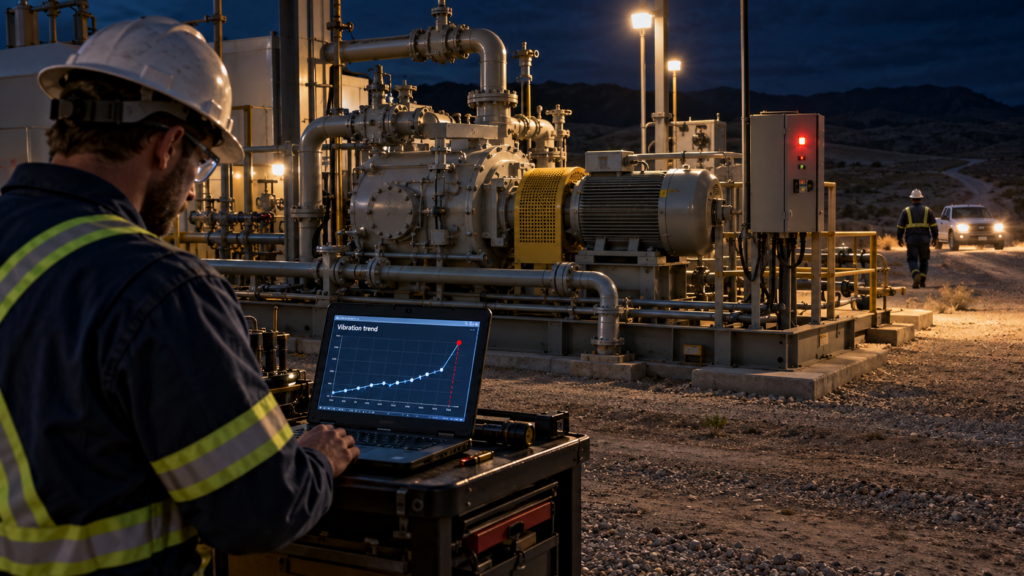
This is the everyday case for How to enable AI in the oil and gas industry. The problem is rarely a shortage of data. It is a shortage of connected data, clear ownership, trusted models and a safe path from insight to action.
Many companies respond with a pilot, and many pilots never leave the pilot stage. The reasons are consistent: the data was never made reliable, operations never owned the result, the model was never wired into maintenance or production workflows, and nobody planned for OT cybersecurity or safety review.
This guide is built to avoid those outcomes. You will get a seven-step roadmap, a use-case prioritization method, technology and tool comparisons, department responsibilities, risks and mitigations, KPIs, a checklist and an action plan. It is written for operations leaders, reliability and production engineers, digital transformation teams and IT/OT managers. No prior AI expertise is assumed.
✔ Key Takeaway: Successful AI in oil and gas is 20% algorithms and 80% data access, workflow integration, safety governance and people. Plan for the 80%.
Quick Answer: How to Enable AI in the Oil and Gas Industry
To enable AI in the oil and gas industry, pick one high-value operational problem, assess your data and OT readiness, connect SCADA, historian and maintenance data securely, pilot a model with engineers in the loop, integrate it into daily workflows, measure results against a baseline, then scale with governance and cybersecurity controls.
What Is AI Enablement in Oil and Gas?
AI enablement means making your organization able to use artificial intelligence reliably in daily operations. That covers far more than buying software. It includes:
- Data: sensor, SCADA, historian, maintenance (CMMS/ERP), subsurface, drilling and document data made accessible and trustworthy.
- Infrastructure: secure OT-to-IT data paths, cloud and edge computing, and connectivity for remote sites.
- Models: machine learning, computer vision, optimization, physics-informed models and generative AI.
- Workflows: alerts that become work orders, recommendations that operators can act on, and clear approval rules.
- People and governance: skills, ownership, safety review, cybersecurity and model monitoring.
Think of it as the difference between owning an engine and having a car that gets you somewhere. The model is the engine. Enablement is everything else.
AI types you will meet in oil and gas
| AI type | What it does | Typical oil and gas use |
| Predictive machine learning | Finds patterns in time-series data to forecast failures or performance | Compressor, pump and ESP failure warnings |
| Computer vision | Interprets images and video | Flare monitoring, leak and corrosion inspection, PPE detection |
| Optimization | Recommends settings that maximize an objective within constraints | Gas lift allocation, refinery unit tuning |
| Physics-informed / surrogate models | Combines engineering physics with ML for fast approximations | Reservoir scenario screening, digital twins |
| Generative AI (LLMs) | Reads, summarizes and drafts text, answers questions over documents | Searching well files, procedures and HSE reports |
| Agentic AI | Chains tasks across tools with oversight | Drafting work packs, triaging alarms (human approval required) |
Expert Tip: Do not start with the technology label. Start with the decision you want to improve, then choose the AI type that fits it.
Why Enable AI Now?
Several pressures make the case stronger than it was a few years ago:
- Cost and margin discipline. Unplanned downtime and reactive maintenance quietly consume budgets.
- Workforce transition. Experienced engineers are retiring, and their pattern recognition is hard to replace. AI can help capture and spread it.
- Data already exists. Most operators have historians, SCADA, maintenance records and decades of reports. The value is stranded, not missing.
- Emissions and safety scrutiny. Regulators, investors and communities expect faster detection and better documentation.
- Mature tooling. Industrial data platforms, edge computing and enterprise-grade generative AI make adoption more practical than before.
The cost of waiting is not dramatic collapse. It is a slow gap: competitors resolve faults earlier, plan turnarounds better and make faster subsurface decisions.
Warning: AI is not a substitute for sound engineering, process safety management or experienced operators. In safety-critical settings it supports decisions; humans remain accountable.
Benefits of AI in Oil and Gas
The table below links each benefit to the lever behind it and how to measure it. Results vary by asset, data quality and execution, so treat these as areas to target and baseline, not guaranteed outcomes.
| Benefit | How AI delivers it | How to measure |
| Less unplanned downtime | Early anomaly and failure warnings on rotating equipment | Unplanned downtime hours, MTBF |
| Lower maintenance cost | Shift from calendar-based to condition-based work | Maintenance cost per asset, emergency work orders |
| Production uplift | Continuous surveillance, virtual metering, lift and setpoint optimization | boe/d vs. baseline, deferred production |
| Lower drilling cost | Real-time parameter advisories, early NPT warnings | NPT days, cost per foot, ROP |
| Faster subsurface decisions | ML-assisted interpretation, surrogate models | Cycle time for interpretation and scenario runs |
| Better HSE performance | Vision-based PPE and hazard detection, risk scoring | Incident rates, near-miss detection |
| Emissions reduction | Continuous leak, flare and methane detection | Detection-to-repair time, emissions intensity |
| Knowledge retention | Generative AI search over reports and procedures | Time to find information, onboarding time |
Best Practice: Record a baseline for every KPI before the pilot starts. Without a baseline, you cannot prove value later.
Where AI Can Be Implemented
Oil and gas spans very different environments, so the best starting point depends on your segment.
| Segment | High-potential AI use cases | Data usually needed | Typical difficulty |
| Upstream: subsurface | Seismic and well-log interpretation support, reservoir surrogate models | Seismic, logs, core, production history | High (specialist data, compute) |
| Upstream: drilling | ROP optimization, stick-slip and vibration detection, NPT early warning | MWD/LWD, surface drilling parameters, daily reports | Medium to high |
| Upstream: production | Artificial lift optimization, ESP failure prediction, virtual metering | Well tests, pressures, temperatures, pump data | Medium |
| Midstream | Pipeline leak and integrity analytics, compressor health, flow assurance | SCADA, pressure/flow, inspection records | Medium |
| Downstream | Predictive maintenance, process optimization, energy efficiency | DCS, historian, lab data, CMMS | Medium |
| Cross-functional | HSE vision analytics, document copilots, supply chain planning | Video, reports, procedures, ERP | Low to medium |
A realistic example of fit. A midstream operator with strong SCADA data but limited data science staff may begin with compressor health monitoring. The data exists, failure modes are well understood and the maintenance workflow is clear. Compare that with starting on reservoir modeling, which needs specialist data, heavy compute and scarce talent.
Common Mistake: Starting with the most exciting use case instead of the one with the best data and clearest owner.
Step-by-Step AI Enablement Roadmap (7 Steps)
This roadmap expands the six-phase view from the research brief by giving governance its own step. Use it as your master plan.
| Step | Focus | Typical duration | Main output |
| 1 | Define the business problem and sponsor | 2–4 weeks | Problem statement, executive sponsor |
| 2 | Assess readiness (data, OT, skills, security) | 3–6 weeks | Readiness scorecard and gap list |
| 3 | Prioritize use cases | 2–4 weeks | Ranked shortlist, first pilot chosen |
| 4 | Build the data foundation and OT/IT integration | 2–6 months | Trusted, secure data pipeline |
| 5 | Run a focused pilot | 3–6 months | Measured results vs. baseline |
| 6 | Operationalize in daily workflows | 3–6 months | Live use, owner, SOPs, training |
| 7 | Scale and govern | 6–24 months | Portfolio, standards, Center of Excellence |
Durations are planning ranges that vary widely by company size and readiness.
Step 1: Define the Business Problem and Secure a Sponsor
What: Write one clear problem statement tied to money, safety or emissions. Why: Projects framed as “use AI” drift. Projects framed as “reduce unplanned compressor trips at Station Group A” get funded and finished. Who: An operations or asset leader as owner, with an executive sponsor who can unblock budget and access. How:
- Interview operators, reliability engineers and planners about their most expensive recurring problems.
- Quantify each problem with your own figures: downtime hours, deferred production, repair cost, incident counts.
- Pick one to three candidates and write a one-page problem statement for each.
Example problem statement: “Reduce unplanned downtime on gas compressors at the northern asset group by giving reliability engineers failure warnings at least several days ahead, so repairs can be planned.”
Expert Tip: Make an operations leader, not IT, the project owner. Business ownership is the strongest predictor of adoption.
Step 2: Assess Readiness
What: A candid check of data, infrastructure, security, skills and culture. Why: Readiness gaps found now cost days. Found mid-pilot, they cost months.
| Readiness area | Questions to ask | Red flag |
| Data availability | Are the needed sensors and tags historized at useful frequency? | Key variables not recorded |
| Data quality | Are tags mapped, timestamps consistent, failures labeled? | Failures only in free-text notes |
| Connectivity | Can data reach analytics from remote sites? | Manual downloads only |
| OT security | Is there a segmented network and a DMZ for data transfer? | Flat network, remote access unmanaged |
| Systems | Can the CMMS accept AI-generated alerts or work orders? | No integration path |
| Skills | Who knows both the equipment and the data? | No domain engineer available |
| Governance | Who approves model changes and recommendations? | No defined decision rights |
| Culture | Will operators act on alerts? | Past tools ignored as noisy |
Quick Checklist: Can you name (1) the owner, (2) the data source, (3) the decision the model supports, (4) the action that follows, and (5) the KPI that proves value? If any answer is blank, pause.
Example: A team wanting ESP failure prediction finds that failures are recorded only as narrative notes. The fix is a short project to standardize failure codes in the CMMS before modeling. That is unglamorous, and it is exactly the work that makes the model possible.
Step 3: Prioritize Use Cases
What: Rank candidates with a simple scoring model. Why: It stops the loudest voice from choosing the project and makes trade-offs visible.
Score each candidate from 1 (poor) to 5 (strong). Weight the criteria to suit your company.
| Criterion | Question | Example weight |
| Business value | How large is the cost, production or risk impact? | 30% |
| Data readiness | Is the data available and reliable now? | 25% |
| Feasibility | Is a proven approach available, and can we integrate it? | 15% |
| Adoption likelihood | Will users trust and use it? | 15% |
| Risk | What is the safety, cyber or regulatory exposure? (score inversely) | 15% |
Illustrative scoring
| Candidate | Value | Data | Feasibility | Adoption | Risk (inverse) | Verdict |
| Compressor failure prediction | 4 | 4 | 4 | 4 | 4 | Strong first pilot |
| Reservoir surrogate modeling | 5 | 2 | 2 | 3 | 4 | Later phase |
| Document copilot for well files | 3 | 3 | 4 | 4 | 3 | Good parallel quick win |
| Autonomous closed-loop control | 5 | 3 | 2 | 2 | 1 | Not yet |
Scores above are examples to show the method, not benchmarks.
Pro Tip: Choose a “value pair”: one operational pilot (for example predictive maintenance) and one low-risk productivity pilot (for example a document assistant). The second builds organizational confidence while the first matures.
Step 4: Build the Data Foundation and OT/IT Integration
What: Create a secure, repeatable path from field data to analytics, and make that data trustworthy. Why: Models are only as good as the data beneath them. This step usually takes the longest and decides whether everything after it works. Who: OT/controls engineers, data engineers, IT, cybersecurity and the domain engineer who knows what each tag means.
The reference data path
- Sensors and controllers (PLCs, RTUs, DCS) collect measurements.
- SCADA and historian (for example PI System or equivalent) store time-series data.
- Edge gateway (optional) filters, buffers and runs lightweight models at remote sites.
- OT DMZ passes data one way or through controlled brokers using OPC UA or MQTT. Analytics does not get direct access to control networks.
- Data platform (cloud, on-premises or hybrid) stores and contextualizes data by asset, not just by tag name.
- Model layer trains, validates and serves models.
- Workflow layer pushes alerts into the CMMS (such as SAP PM or IBM Maximo), dashboards and operator displays.
Key tasks
- Map tags to an asset hierarchy so “PT-4021” becomes “Compressor 3, discharge pressure”.
- Check sampling rates, timestamps, units and sensor drift.
- Label history: failure events, maintenance actions, operating modes. Labeled failures are often the scarcest ingredient.
- Define data ownership and access rules.
- Apply segmentation and monitoring aligned with IEC 62443 and NIST guidance for OT security.
| Data source | Typical content | Common problem | Fix |
| SCADA/historian | Pressures, temperatures, flows, vibration | Gaps, compressed data, inconsistent tag names | Tag mapping, review compression settings |
| CMMS/ERP | Work orders, failure codes, parts | Free-text failures, inconsistent coding | Standardize failure codes, enrich history |
| Subsurface | Logs, seismic, core, models | Scattered formats and silos | Adopt common data standards such as OSDU |
| Drilling | WITSML streams, daily reports | Mixed formats, late reports | Streaming ingestion, structured report templates |
| Documents | Procedures, inspections, HSE reports | Scanned PDFs, no metadata | OCR, tagging, access controls for RAG |
| Video/imagery | Cameras, drones, thermal/optical gas imaging | Storage cost, labeling effort | Edge filtering, targeted labeling |
Common Mistake: Giving analytics tools direct access to control networks to “save time”. Always use a segmented architecture with a DMZ and strong access control.
Expert Tip: Spend your first data-engineering weeks on one asset class (for example, one compressor model), not the whole enterprise. A clean, small foundation beats a messy large one.
Example: A team building compressor health analytics discovers three sites name the same discharge-pressure signal differently. They create a shared asset template, so one model can later be reused across all sites instead of being rebuilt three times.
Step 5: Run a Focused Pilot
What: A time-boxed project on a limited set of assets, designed to prove value or learn quickly. Why: It limits risk and builds the evidence needed for investment. Who: A small cross-functional squad: domain engineer, data scientist or ML engineer, OT engineer, operator or planner representative, and the business owner.
How to run it
- Set success criteria up front. For example: warn of a defined failure mode with enough lead time for planned repair, with an acceptable false-alarm rate agreed with operators.
- Start in advisory mode. The model flags; humans decide.
- Validate on history first. Back-test against past failures, then run in shadow mode alongside live operations.
- Review alerts weekly with the engineers who receive them. Tune thresholds based on their feedback.
- Compare against the baseline recorded in Step 1.
- Decide: scale, adjust or stop. Stopping a project that does not work is a valid and valuable outcome.
Best Practice: Define in advance how many false alarms users will tolerate. Alert fatigue kills more AI projects than weak algorithms.
Warning: Do not connect any AI output to automated control actions during a pilot. Closed-loop control needs separate safety review, testing and management of change (MOC).
Example: A downstream site shadow-runs a pump health model for three months. Engineers compare its flags with actual repairs and find it detects bearing issues well but over-alerts at startup. They add an operating-mode filter, and trust grows because the team shaped the fix.
Step 6: Operationalize in Daily Workflows
What: Turn a successful pilot into a normal part of how work happens. Why: A model nobody opens is a sunk cost. Adoption comes from integration, training and clear ownership.
Operationalization tasks
- Integrate alerts into the CMMS, planning meetings and operator screens, not a separate dashboard people forget.
- Define roles: who receives alerts, who validates, who closes the loop, who maintains the model.
- Update SOPs and MOC records to reflect the new decision process.
- Train users on what the model sees, what it cannot see and how to challenge it.
- Monitor models for drift as equipment, operating modes and sensors change. Schedule retraining.
- Provide explanations (key signals, trend context) so engineers can verify a flag in minutes.
Key Takeaway: The trust test is simple: when a model flags a problem, does an engineer open the trend chart and agree or disagree quickly? Explainability and workflow design make that possible.
Step 7: Scale and Govern
What: Replicate success across assets and use cases under shared standards. Why: Isolated wins do not change an enterprise. Standards and reuse do.
How to scale
- Create reusable templates: asset models, data pipelines, model packages, dashboards.
- Form a Center of Excellence (even two or three people at first) to maintain standards, share lessons and support sites.
- Establish AI governance: approval path for new models, risk tiering, documentation, audit trail, incident response. Frameworks such as the NIST AI Risk Management Framework and ISO/IEC 42001 provide structure.
- Run a value tracker showing realized benefits per use case, reviewed by leadership.
- Retire what does not work. A smaller portfolio of used tools beats a large shelf of ignored ones.
- Keep humans in control: define which decisions are advisory, which need approval and which are never automated.
- Track regulation. Requirements such as the EU AI Act, emissions rules and process-safety obligations differ by region and change over time. Confirm current requirements for your jurisdiction.
AI Technologies Used
Different problems call for different technologies. Use this table to match the technology to the business function.
| Technology | Best for | Strengths | Limitations | Typical function |
| Time-series ML (gradient boosting, LSTM, transformers) | Anomaly detection, failure prediction, forecasting | Works well with historian data | Needs labeled failures; drift over time | Reliability, production |
| Computer vision | Inspection, leak, flare, PPE detection | Scales human visual checks | Labeling effort, lighting and weather variation | HSE, integrity, emissions |
| Physics-informed and surrogate models | Reservoir, flow, digital twins | Respects physical laws, fast scenarios | Requires specialist expertise | Subsurface, process engineering |
| Optimization and reinforcement learning | Lift allocation, setpoints, scheduling | Handles many variables and constraints | Needs good simulators and safety limits | Production, refining |
| LLMs with retrieval (RAG) | Searching and summarizing documents | Fast knowledge access, natural language | Hallucination risk; needs grounding, citations and access control | Engineering, HSE, drilling |
| Edge AI | Remote or latency-sensitive sites | Works with poor connectivity, lower data transfer | Limited compute, device management | Wellsites, pipelines, platforms |
| Digital twins | Simulating assets and processes | Scenario testing, shared view | Maintenance of model fidelity | Operations, planning |
Cloud, edge or hybrid?
| Option | Choose when | Watch out for |
| Cloud | You need scalable training, enterprise-wide analytics, cross-site comparison | Connectivity, data-sovereignty rules, cost control |
| Edge | Sites are remote, latency matters, or bandwidth is limited | Device lifecycle and update management |
| Hybrid | Most oil and gas cases: train centrally, infer at the edge | Architecture complexity; clear ownership needed |
Pro Tip: For remote wellsites, a common pattern is to train models in the cloud, deploy compact versions on edge gateways and send only exceptions and summaries upstream.
Best AI Tools and Platforms
Tools change quickly, and fit depends on your systems, vendors and skills. Use the table to shortlist, then validate through official documentation and a proof of value. This is not a ranking or endorsement.
| Tool / platform | Purpose | Advantages | Limitations | Ideal use case |
| AVEVA PI System | Industrial historian and data infrastructure | Widely deployed time-series foundation | Not an ML platform alone | Data backbone feeding analytics |
| Seeq | Time-series analytics | Engineer-friendly, low-code, quick pilots | Less suited for heavy custom ML | Process and reliability prototyping |
| Cognite Data Fusion | Industrial data contextualization | Asset-centric model, OSDU-friendly | Implementation effort, vendor dependency | Unifying OT, IT and engineering data |
| C3 AI applications | Packaged industrial AI apps | Ready predictive maintenance and production apps | Premium cost, customization | Large operators wanting packaged apps |
| AspenTech (e.g., Aspen Mtell) | Predictive maintenance, process optimization | Deep process-industry heritage | Mostly downstream and process focus | Refineries, gas processing |
| SLB, Halliburton, Baker Hughes platforms | Subsurface, drilling, production and asset-health software | Domain depth, OEM equipment knowledge | Ecosystem tie-in, cost | Reservoir, drilling, artificial lift, rotating equipment |
| Honeywell Forge | Industrial performance management | Strong in refining and facilities | Broad rollout complexity | Downstream and facility performance |
| Microsoft Azure, AWS, Google Cloud | Cloud data, ML, IoT and generative AI services | Scale, broad services, OSDU support in some clouds | Requires in-house skills, cost management | Enterprise data and AI platform |
| NVIDIA accelerated computing | GPU compute, simulation, digital twins | Speeds seismic, reservoir and twin workloads | Hardware cost, specialist skills | Seismic processing, simulation |
| Databricks, Snowflake | Lakehouse analytics and MLOps | Scalable data and model lifecycle | Not OT-native; needs ingestion layer | Enterprise analytics |
| LLM assistants with RAG (Claude, GPT, Gemini families) | Document search, summarization, drafting | Fast knowledge access, natural language | Needs grounding, permissions and review | Well files, procedures, HSE reports |
How to choose a tool
- Does it integrate with your historian, CMMS and security model?
- Can it run where you need it (cloud, edge, on-premises)?
- Is the data model open (OSDU, OPC UA, standard APIs) or proprietary?
- Can your own engineers configure and explain it?
- What is the exit path if you change vendors?
- Will the vendor commit to a paid or time-boxed proof of value with agreed success criteria?
Build, buy or partner?
| Approach | Best when | Trade-off |
| Buy packaged | Use case is common (predictive maintenance on standard equipment) | Faster, less customizable, licensing cost |
| Build in-house | Differentiating use case and strong data team | Highest control, needs sustained talent |
| Partner | You need speed plus knowledge transfer | Insist on documentation and skills transfer |
Expert Tip: Prefer platforms that keep your data portable. Vendor lock-in often surfaces only at renewal time.
Implementation Process: Timeline, Teams and Costs
Who does what
| Department | AI responsibility |
| Operations | Owns the problem, validates outputs, acts on recommendations |
| Reliability and Maintenance | Defines failure modes, labels history, integrates with work orders |
| Production / Drilling / Subsurface Engineering | Provides domain logic, evaluates model results |
| IT | Cloud and enterprise integration, platform operations |
| OT / Controls | Safe data access, network segmentation, change control |
| Cybersecurity | Threat modeling, access control, monitoring, vendor security review |
| HSE and Process Safety | Risk review, MOC, safe use boundaries |
| Data Science / Analytics | Modeling, validation, monitoring, documentation |
| Procurement and Legal | Contracts, data rights, IP, vendor terms |
| Finance | Value tracking, business case review |
| HR / Training | Upskilling, role changes, change management |
Costs versus expected benefits
Published cost figures vary too widely to quote responsibly. Use the structure below to build your own business case with internal numbers and vendor quotes.
| Cost category | What it includes | Related benefit to quantify |
| Data and integration | Connectors, historian upgrades, data engineering | Faster future projects, reusable foundation |
| Software and cloud | Licenses, compute, storage | Avoided downtime, production uplift |
| Hardware | Sensors, edge gateways, cameras | Coverage of previously unmonitored assets |
| People and skills | Hires, training, partners | Retained knowledge, faster decisions |
| Security and governance | Assessments, monitoring, audits | Reduced cyber and compliance risk |
| Change management | Training, SOP updates, communications | Higher adoption, realized value |
Pro Tip: Include the cost of not acting in your business case: repeat failures, deferred production and the loss of retiring experts’ knowledge.
Common Challenges and Solutions
| Risk or challenge | Why it happens | Mitigation |
| Poor or siloed data | Legacy systems, inconsistent tags | Asset-based data model, data governance, start with one asset class |
| Pilot purgatory | No owner, no workflow integration | Business ownership, scale criteria defined before the pilot |
| OT cyber exposure | Direct connections, weak segmentation | DMZ architecture, IEC 62443 practices, least-privilege access, vendor reviews |
| Alert fatigue | Too many false positives | Agree tolerances upfront, tune with users, operating-mode filters |
| Limited connectivity | Remote sites, offshore | Edge inference, store-and-forward, satellite links where justified |
| Skills gap | Few people understand both domain and data | Domain-plus-data squads, partner with knowledge transfer, targeted training |
| Model drift | Equipment, fuel and operating conditions change | Monitoring, scheduled retraining, ownership of MLOps |
| Distrust from field teams | Black-box outputs, past failed tools | Explainability, involve operators early, show lead-time value |
| Safety and regulatory concerns | Unclear boundaries for AI-driven actions | Advisory first, MOC, risk tiering, documented approvals |
| Vendor lock-in | Proprietary data formats | Open standards, data portability clauses |
| GenAI hallucination | Ungrounded answers | RAG with citations, permission-aware search, human review |
| Unclear ROI | No baseline | Baseline KPIs before pilot, value tracker |
Common Mistake: Treating cybersecurity as a final-stage review. Involve security teams in Step 2, not Step 6.
Best Practices
- Start with a problem, not a platform. Technology follows the decision you want to improve.
- Keep experts in the loop. Domain engineers should co-own models, not just receive them.
- Go advisory before autonomous. Earn trust, then discuss closed-loop control with full safety review.
- Standardize early. Common asset models and naming make scaling realistic.
- Design for adoption. Put outputs where people already work.
- Document everything. Data sources, assumptions, validation results and limits support audits and onboarding.
- Protect sensitive data. Apply access controls to documents, and never paste confidential operational data into unapproved AI tools. Use enterprise agreements with clear data-handling terms.
- Measure honestly. Report misses along with wins. Credibility compounds.
- Invest in people. Training operators and engineers to question models is a safety feature.
Best Practice: Write a one-page “AI use policy” for staff: approved tools, data classification rules, review requirements and who to ask. It prevents shadow AI without slowing teams down.
Real-World Examples
The scenarios below are illustrative composites that show how enablement works in practice. They are not reports of specific companies or results. For documented company programs, consult operator and vendor publications, SPE papers (OnePetro) and IEA analysis, and verify the details before citing them.
Example 1: Predictive maintenance for midstream compressors
- Problem: Unplanned trips at compressor stations.
- Data: Vibration, temperature, pressure and run-hour data from the historian, plus work-order history.
- Enablement steps: Clean tag mapping, standardize failure codes, build an anomaly model, shadow-run for several months, route validated alerts to the CMMS.
- Human role: Reliability engineers review each alert and decide on intervention.
- Success measure: Fewer unplanned trips, more planned repairs, alert precision accepted by engineers.
Example 2: Artificial lift surveillance in production
- Problem: Engineers cannot review hundreds of wells daily.
- Approach: Rank wells by anomaly score and likely cause (for example, pump wear or gas interference), so engineers review exceptions only.
- Human role: Production engineers confirm and decide on adjustments.
- Success measure: Time to detect issues, deferred production, engineer hours saved.
Example 3: Generative AI assistant for well and drilling files
- Problem: Finding offset-well lessons buried in thousands of reports.
- Approach: Permission-aware retrieval over curated documents, answers shown with source citations.
- Guardrails: Restricted corpus, access controls matching existing permissions, mandatory source links, human verification for any engineering decision.
- Success measure: Search time, reuse of lessons learned, user trust ratings.
Example 4: Vision-based methane and flare monitoring
- Problem: Periodic surveys miss intermittent events.
- Approach: Optical or thermal gas imaging cameras and sensors feed detection models, with alerts routed to field crews.
- Guardrails: Verification procedures for alerts, calibration, documented response times.
- Success measure: Detection-to-repair time, reporting quality and regulatory alignment.
Before vs. After AI Enablement
| Activity | Before | After |
| Equipment monitoring | Operators watch trends and alarms | Models score signals continuously; engineers review exceptions |
| Maintenance planning | Calendar-based or after failure | Risk-informed, planned around predicted condition |
| Well surveillance | Periodic test review | Continuous ranking of wells needing attention |
| Knowledge access | Ask a colleague or search folders | Cited answers from curated documents |
| Emissions detection | Scheduled surveys | Continuous monitoring with defined response |
| Reporting | Manual compilation | Automated drafts reviewed by people |
Future Trends
These trends reflect where the field is heading. Direction is more reliable than dates, so verify timelines for your context.
- Agentic workflows with approvals. AI agents that gather data, draft work packs and prepare reports, with humans approving actions.
- Edge AI becomes standard. More inference at wellsites, pipelines and platforms as hardware improves.
- Digital twins for decisions. Wider use of asset-level twins for planning and scenario testing.
- Generative AI inside engineering tools. Natural-language access to subsurface, drilling and maintenance data, with grounding and citations.
- Automated emissions intelligence. Continuous detection and quantification tied to regulatory reporting.
- Open data standards. OSDU and similar standards reduce silos and vendor lock-in.
- Stronger AI governance. Regulation and customer expectations push for documentation, testing and auditability.
- Sovereign and private AI. Operators with sensitive data increasingly prefer private deployments or tightly controlled environments.
- Autonomy in narrow domains. Selected closed-loop applications (for example, defined drilling or process tasks) expand slowly, under strict safety cases.
Implementation Checklist
Strategy
- ☐ Problem statement written with a business owner and executive sponsor
- ☐ Baseline KPIs recorded
- ☐ Use cases scored and one pilot selected
Data and infrastructure
- ☐ Required tags and records identified and accessible
- ☐ Tag-to-asset mapping completed for pilot assets
- ☐ Failure and event history labeled
- ☐ Secure OT-to-IT data path designed and approved
- ☐ Cloud/edge/hybrid decision made
Security and governance
- ☐ Cybersecurity review completed (IEC 62443 / NIST-aligned)
- ☐ Data-handling and AI use policy issued
- ☐ Model approval and change-control process defined
- ☐ Safety review and MOC path confirmed
Pilot and rollout
- ☐ Success criteria and false-alarm tolerance agreed with users
- ☐ Shadow-mode validation completed
- ☐ Alerts integrated into CMMS and daily routines
- ☐ Users trained; SOPs updated
- ☐ Monitoring and retraining owner named
Scale
- ☐ Reusable templates documented
- ☐ Value tracker reviewed by leadership
- ☐ Next three use cases ranked
KPI Measurement Table
| KPI | Why it matters | Source | Review rhythm |
| Unplanned downtime hours | Direct operational impact | Historian, CMMS | Monthly |
| MTBF / MTTR | Reliability trend | CMMS | Monthly |
| Alert precision and recall | Model quality and trust | Model logs, engineer feedback | Weekly in pilot |
| Lead time of warnings | Value for planned repair | Model and work-order records | Per event |
| Production uplift or deferred production | Financial value | Production allocation | Monthly |
| NPT days (drilling) | Drilling efficiency | Daily drilling reports | Per well |
| Detection-to-repair time (emissions) | Environmental performance | Monitoring and work orders | Monthly |
| Adoption rate (alerts acted on) | Real use | Workflow system | Monthly |
| Time saved in engineering tasks | Productivity | User surveys, system logs | Quarterly |
People Also Ask
1. How is AI used in the oil and gas industry? AI supports predictive maintenance, production optimization, drilling analytics, seismic and reservoir interpretation, emissions and leak detection, HSE monitoring and document search. Humans remain responsible for safety-critical decisions.
2. What is the first step to implement AI in oil and gas? Choose one high-value operational problem, name a business owner, and record baseline KPIs. Then assess whether the data, OT security and workflows are ready.
3. What data do you need for AI in oil and gas? Commonly sensor and SCADA time-series from a historian, maintenance and failure records from the CMMS, production and well-test data, drilling data, and documents. Labeled failure history is often the scarcest.
4. How long does AI implementation take in oil and gas? A first pilot often takes several months once data is accessible, with data foundation work frequently taking longest. Enterprise scaling can take years. Timelines vary widely.
5. How do you integrate AI with SCADA? Do not connect AI directly to control networks. Use a historian or data broker, pass data through a DMZ using protocols such as OPC UA or MQTT, and send recommendations back through approved workflows.
6. Should oil and gas companies build or buy AI? Buy packaged solutions for common use cases, build for differentiating ones, and partner when you need speed with knowledge transfer. Many companies combine all three.
7. Why do AI projects fail in oil and gas? Common causes are poor data, no business owner, weak workflow integration, too many false alarms and neglected change management.
8. Is AI safe to use in process control environments? Advisory AI is widely practical. Closed-loop control requires separate safety cases, testing, MOC and regulatory consideration. Treat it as a later, carefully governed step.
9. How do you secure AI in OT networks? Use segmentation, a DMZ, least-privilege access, monitoring, vendor security reviews and standards such as IEC 62443 and NIST SP 800-82.
10. Can small oil and gas companies use AI? Yes. Start with focused use cases such as compressor or pump health, production surveillance or document search, often using vendor-supported tools rather than large internal teams.
11. Will generative AI replace engineers in oil and gas? It is better viewed as an assistant for search, drafting and summarization. Engineering judgment and accountability stay with people.
12. How do you measure AI success? Compare KPIs such as unplanned downtime, deferred production, NPT, alert precision and adoption against the baseline recorded before the pilot.
13. What are the best AI tools for oil and gas? There is no universal best. Common options include historian and analytics platforms (AVEVA PI, Seeq), industrial data platforms (Cognite), packaged applications (C3 AI, AspenTech), operator-service platforms (SLB, Halliburton, Baker Hughes) and cloud AI services.
14. What skills are needed? Domain engineering, data engineering, ML, OT and controls, cybersecurity, product ownership and change management.
15. What is the future of AI in oil and gas? Expect more edge AI, digital twins, grounded generative AI, agentic workflows with approvals, and stronger governance.
Frequently Asked Questions
Do we need a data lake before starting? Not necessarily. A pilot can run on a focused data pipeline for one asset class. Build broader platforms as value is proven.
What if our failure history is incomplete? Use anomaly detection and engineering rules at first, then improve labeling as new events occur. Standardizing failure codes now pays off later.
Can we use public cloud with sensitive operational data? Many operators do, using private connectivity, encryption, access controls and contractual data protections. Requirements vary by jurisdiction and company policy, so involve security and legal teams.
How do we prevent staff from pasting confidential data into public chatbots? Provide approved enterprise tools, publish a clear AI use policy, classify data and train staff.
How many false alarms are acceptable? There is no universal number. Agree on a tolerance with the people receiving alerts, because their willingness to act determines success.
How do we handle model drift? Monitor input distributions and alert accuracy, schedule retraining, and revalidate after major equipment or operating changes.
Do we need new sensors? Sometimes. First test what existing data can do, then add sensors where gaps limit a high-value use case.
How do we get field crews to adopt AI? Involve them early, show how it saves effort, explain alerts clearly and act on their feedback visibly.
What contract terms matter with AI vendors? Data ownership, model and IP rights, portability, security obligations, audit rights, service levels and exit provisions.
Is a Center of Excellence necessary? Not at the start, but a small coordinating team becomes valuable once more than two or three use cases are running.
How should generative AI be restricted in operations? Use it for search, summaries and drafts over approved content with citations. Do not let it issue unreviewed instructions for safety-critical tasks.
What regulations should we watch? Process safety rules, emissions and methane regulations, data protection, OT security expectations and AI-specific laws such as the EU AI Act where applicable. Confirm current requirements locally.
How do we budget for ongoing operation? Plan for cloud and licenses, monitoring, retraining, support, security reviews and user training, not just the initial build.
Conclusion
Enabling AI in the oil and gas industry is not a technology purchase. It is an operating-model change built on trusted data, secure OT/IT integration, engineer-owned models, clear workflows and disciplined governance.
Companies that succeed tend to do the same things: they choose a specific problem, fix the data that problem needs, pilot with the people who will use the result, integrate it into daily work, measure honestly and then scale with standards. Those that stall usually skip one of those steps.
You do not need a giant program to begin. You need one problem, one owner, one pilot and a plan to prove value. That is how how to enable AI in the oil and gas industry becomes a practical project rather than a slide in a strategy deck.
✔ Key Takeaway: Start small, start with data and ownership, keep humans accountable, and build for scale from the first pilot.
Action Plan: Your First 90 Days
| Timeframe | Actions | Output |
| Days 1–30 | Interview operations and reliability teams; draft problem statements; record baseline KPIs; run the readiness assessment; brief security and HSE | Problem statements, readiness scorecard |
| Days 31–60 | Score use cases; select a pilot and a low-risk productivity pilot; map data sources; design the secure data path; define success and false-alarm tolerance | Chosen pilots, data plan, architecture sketch |
| Days 61–90 | Connect and clean pilot data; back-test models; start shadow mode; train pilot users; set review cadence | Working data pipeline, first validation results |
Next actions this week
- Name the business owner and executive sponsor.
- List your top five recurring operational problems with their costs.
- Ask IT and OT to map where relevant data lives today.
- Schedule an early conversation with cybersecurity and HSE.