
Picture a regional utility on a cold January night. A transformer that showed no obvious warning signs fails, a feeder drops out, and crews spend hours finding the fault. Afterward, engineers dig through historian data and notice the signals had been drifting for weeks. Nobody was looking, because nobody had time to look at every asset every day.
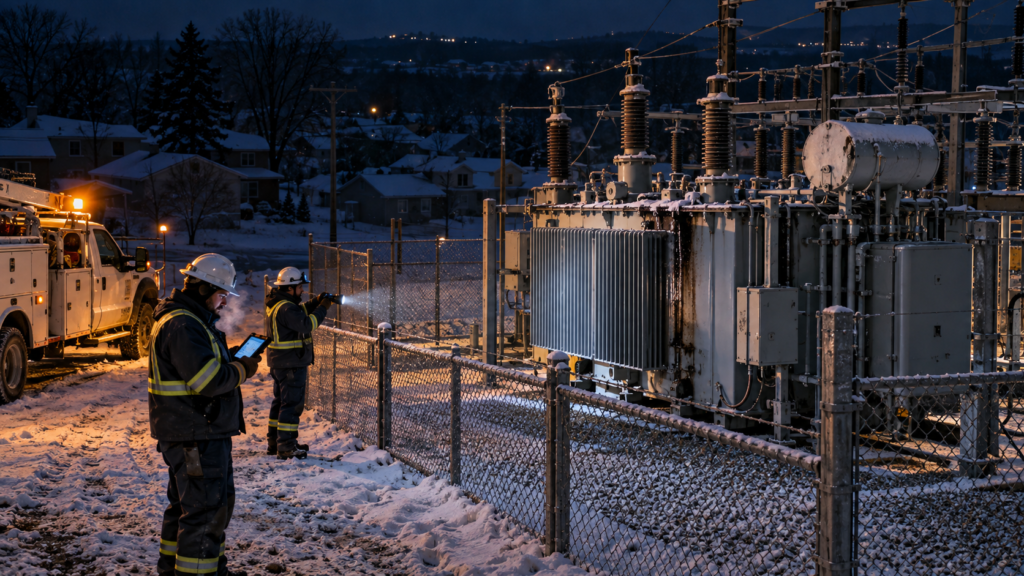
That is the gap AI closes, and it is why energy companies are moving fast. One survey of 100 energy executives found about 40% already use AI in core operations, and 95% had implemented it to a moderate or large extent (BRG, via ColoradoBiz). Yet the same research shows the barriers are consistent: cybersecurity worries, messy data and a shortage of skilled people. Waiting does not remove those barriers. It lets the gap between you and better-prepared competitors widen.
This guide shows exactly how to enable AI in the energy industry: where to start, which data and systems you need, how to stay compliant and secure, which tools fit which job, and how to move from a pilot to results you can measure. It is written for operations, asset, IT/OT and digital leaders at utilities, oil and gas companies and renewable operators, and it assumes no prior AI expertise.
Quick answer
To enable AI in the energy industry, choose one high-value use case such as predictive maintenance or load forecasting, unify and clean the operational data, set governance aligned with NIST AI RMF and NERC CIP, pilot on a bounded set of assets, integrate results into daily workflows, then scale with monitoring and training.
Key Takeaway: AI enablement is a sequence of business and engineering decisions, not a software purchase. The companies that scale AI treat data, security and people as part of the project from day one.
What is AI enablement in the energy industry?
Forwarding how to enable AI in the energy industry: AI enablement is the work of making AI usable, safe and valuable inside real energy operations. It covers the data pipelines, connections to SCADA and asset systems, security controls, models, and the training that lets operators trust and act on what the models say.
It is different from buying an analytics tool. A forecasting model that nobody can connect to the control room schedule, or an alert nobody trusts, is a pilot, not enablement.
- What: Connecting AI models to operational data and daily decisions.
- Why: To cut downtime and cost, improve forecasts, and manage a more variable grid.
- Who: Operations, asset management, IT, OT, cybersecurity and data teams together.
- When: Start when you have a defined problem, an executive sponsor and access to the relevant data.
Common Mistake: Starting with a technology (“we need a generative AI strategy”) instead of an operational problem (“unplanned compressor trips cost us production”). The problem decides the model, the data and the success metric.
Why enable AI, and what are the benefits?
Three pressures push energy companies toward AI at the same time: rising and less predictable demand, a more variable supply mix, and a workforce that is stretched thin. The IEA projects that electricity demand from data centres worldwide will more than double by 2030 to around 945 TWh, with AI the biggest driver (IEA). The same IEA analysis says AI could cut energy costs in heavy industry by 3–10 percentage points, though skills and data access hold back uptake (Investment Monitor).
The practical benefits fall into five groups:
- Reliability: earlier warning of equipment failure and outages.
- Cost: fewer emergency repairs, better-timed maintenance, less wasted fuel and energy.
- Forecast quality: sharper demand, solar and wind forecasts that improve dispatch and trading.
- Safety and compliance: automated inspection, leak and emissions detection, faster reporting.
- Workforce leverage: engineers spend time on decisions instead of searching data and documents.
| Benefit | What changes | Typical first use case | Honest limit |
| Fewer unplanned outages | Failures flagged days ahead | Predictive maintenance on rotating equipment | Needs sensor data and failure history |
| Better forecasts | Lower forecast error | Load and renewable forecasting | Accuracy depends on weather data quality |
| Lower O&M cost | Work shifts from reactive to planned | Work-order prioritization | Savings vary widely by asset base |
| Faster knowledge access | Hours of searching become minutes | Assistant over manuals and procedures | Needs access control and answer checking |
| Grid flexibility | Smarter use of storage and DERs | Battery dispatch optimization | Requires market and control integration |
Key Takeaway: Quote benefits as ranges tied to your own baseline. Published results vary by asset, data quality and maturity, and none transfer automatically to your site.
Expert Tip: Record 6–12 months of baseline metrics (downtime hours, forecast error, maintenance cost per asset) before the pilot. Without a baseline you cannot prove the value later.
Where AI can be implemented in the energy industry
Start from the value chain. Each segment has proven, lower-risk entry points and harder, later ones. In S&P Global’s 451 Research survey, predictive maintenance (75%) and energy demand forecasting (74%) drew the most attention among utilities, while supply chain and logistics optimization led in upstream (71%) and downstream (73%) oil and gas (S&P Global).
| Segment | AI use case | Data it needs | Risk level | Good first project? |
| Power generation | Turbine and generator predictive maintenance | Vibration, temperature, pressure, failure logs | Low (advisory) | Yes |
| Transmission and distribution | Outage prediction, transformer health, vegetation risk from imagery | SCADA, AMI, weather, GIS, inspection images | Medium | Yes, with a bounded region |
| Grid operations | Anomaly detection, decision support for operators | SCADA/EMS events, topology | High (near control) | Later, advisory mode first |
| Renewables | Solar and wind output forecasting, turbine condition monitoring | Weather, SCADA, inverter data | Low | Yes |
| Storage and DERs | Battery dispatch, virtual power plant coordination | Prices, state of charge, load, weather | Medium | After forecasting works |
| Upstream oil and gas | Drilling and production optimization, reservoir interpretation | Well logs, seismic, real-time drilling data | Medium | With domain partner |
| Midstream | Pipeline leak and integrity detection | Flow, pressure, inspection data | Medium-high | Yes, with strong HSE review |
| Downstream | Refinery process optimization, supply-chain planning | Process historian, lab, logistics data | Medium | Yes (planning first) |
| Trading and planning | Price and demand forecasting | Market, weather, load data | Low-medium | Yes |
| Customer and corporate | Service assistants, billing, compliance reporting | Customer, billing, policy documents | Low | Yes, quick win |
Best Practice: Pick a first project that is advisory (the AI recommends, a human decides), has existing sensor data and a measurable cost. Predictive maintenance on a defined asset class fits all three.
Warning: Do not start with closed-loop control of grid or plant equipment. Autonomy should be earned in stages after the model has proven itself in advisory mode.
Step-by-step AI enablement roadmap
The roadmap has six steps. Each has an owner, an output and a gate you must pass before spending more.
Step 1: Choose use cases with a scoring matrix
List 8–10 ideas, then score each from 1 to 5 on business value, data availability, technical feasibility, safety and regulatory risk (reverse-scored), and operator readiness. Fund the top two or three.
- Who: operations and asset leaders with finance and IT.
- Output: ranked shortlist, a named business owner, a baseline KPI.
- Example: a gas-fired plant ranks compressor predictive maintenance first because vibration and temperature sensors already feed the historian and unplanned trips are costly.
Common Mistake: Funding ten pilots at once. Finding ten viable use cases does not mean building ten. Depth beats breadth.
Step 2: Assess and build the data foundation
Inventory the data the use case needs: SCADA tags, historian records, work orders from your EAM/CMMS, GIS, weather and meter data. Check sampling rate, gaps, units, time alignment and whether failures were ever recorded.
- Who: data engineering with OT engineers who know what the tags mean.
- Output: data inventory, quality baseline, a pipeline that copies data out of OT into an analytics environment.
- Example: a utility discovers its failure history lives in free-text work orders and uses text extraction to label past events.
Pro Tip: Ask OT engineers to explain ten key tags before any modeling. Misread units and mislabeled tags are the most common silent errors.
Step 3: Set governance, security and compliance
Do this before the pilot, not after. Use the NIST AI Risk Management Framework (Govern, Map, Measure, Manage) as the backbone, consider ISO/IEC 42001 for a certifiable management system, and map the AI system into your NERC CIP and IEC 62443 controls if it touches the bulk electric system or control environments. NIST has also circulated a concept note for a critical-infrastructure AI profile, so align early (Tech Jack Solutions summary).
- Who: cybersecurity, legal and regulatory, OT, data governance.
- Output: AI policy, model inventory, risk rating per use case, human-oversight rules.
Warning: Some compliance guidance notes that current NERC CIP and IEC 62443 do not specifically address autonomous AI agents (Aurascape). Keep agents out of control paths and confirm requirements with your compliance team.
Step 4: Run a bounded pilot
Pick a defined asset group or region, run the model alongside existing practice, and let operators review its outputs for at least one operating cycle. Compare against the baseline.
- Who: a small cross-functional team: product owner, data scientist, OT engineer, reliability engineer, operator champion.
- Output: measured results, false-alarm rate, operator feedback.
- Gate: hit the target KPI against baseline for about 90 days before scaling.
Step 5: Integrate into daily workflows
A model creates value only when its output changes a decision. Connect alerts to work-order creation in your EAM, show recommendations in the tools operators already use, and write runbooks for what to do when an alert fires.
- Who: IT and OT integration, maintenance planning, training.
- Output: production deployment, rollback plan, trained users.
Step 6: Scale and optimize
Add monitoring for model drift, schedule retraining, reuse the data platform for the next use case and form a small centre of excellence that owns standards, tooling and the model inventory.
Key Takeaway: Scaling is mostly operational discipline: monitoring, ownership and reuse, not bigger models.
Timeline and gates
| Phase | Months (typical) | Main output | Gate to proceed |
| Use-case selection | 0–2 | Ranked shortlist, funded owner | Business case approved |
| Data and governance | 1–5 | Data pipeline, AI policy, risk ratings | Data readiness met for pilot assets |
| Pilot | 4–9 | Measured results vs baseline | KPI target hit for ~90 days |
| Integration | 9–18 | Production workflow, MLOps, runbooks | Monitoring and rollback proven |
| Scale | 18+ | More use cases, centre of excellence | Annual portfolio ROI review |
These durations are planning ranges, not guarantees; they shrink with clean data and a motivated owner and stretch with legacy OT and long approval cycles.
AI technologies used in energy
You do not need every technology. Match the technique to the problem.
| Technology | What it does | Energy use | Best when | Watch out for |
| Time-series machine learning | Learns patterns in sensor and meter data | Load, price and renewable forecasting | You have months of clean history | Weather and regime shifts |
| Anomaly detection | Flags behavior that departs from normal | Equipment health, grid events | Failures are rare or unlabeled | False alarms if baselines are poor |
| Computer vision | Reads images and video | Drone and satellite inspection, vegetation, flare monitoring | Visual inspection is manual today | Image labeling effort |
| Physics-informed and digital-twin models | Combine engineering physics with data | Turbines, substations, process units | Little failure data but good engineering models | Build cost, specialist skills |
| Reinforcement learning and optimization | Finds best actions under constraints | Battery dispatch, process setpoints | A reliable simulator exists | Safety validation before real use |
| Generative AI with retrieval | Answers questions from documents | Manuals, procedures, filings, field notes | Knowledge is scattered | Must be restricted and checked, never in control loops |
| AI agents | Plan and carry out multi-step tasks | Work-order prep, report drafting | Tasks are well bounded | Governance gaps; keep humans approving actions |
| Edge AI | Runs models near the asset | Remote wells, wind sites | Connectivity is poor or latency matters | Device management at scale |
Expert Tip: Simpler models often win in operations. A well-tuned gradient-boosted model that operators understand will usually beat a complex one they distrust.
Best AI tools for energy companies
Choose by job, not by brand. The table lists representative platforms; product names and packaging change often, so confirm details in each vendor’s current documentation before buying.
| Tool or platform | Purpose | Advantages | Limitations | Ideal use case |
| C3 AI | Enterprise AI applications for asset reliability | Prebuilt energy applications; large-scale deployments | Enterprise cost; heavy implementation | Fleet-wide predictive maintenance |
| AVEVA PI System | Process historian and data layer | Widely installed; strong time-series foundation | Not a modeling platform by itself | Unifying SCADA and plant data |
| GE Vernova APM | Asset performance management | Power-asset expertise | Strongest around its own equipment | Generation and T&D asset health |
| Siemens industrial AI offerings | Condition monitoring | Broad asset coverage; OT credibility | Best in Siemens-based estates | Rotating-equipment monitoring |
| IBM Maximo | Asset management with predictive features | Links predictions to work orders | Needs clean asset data | Utilities already on Maximo |
| Microsoft Azure | Cloud ML, IoT, assistants | Enterprise integration and security | Cost and OT connectivity need design | Hybrid AI platform |
| Google Cloud | Data warehouse, ML, forecasting | Strong analytics pipelines | Fewer native OT connectors | Demand and renewable forecasting |
| AWS | ML build and industrial ingestion | Mature MLOps and edge options | Needs engineering skill | Custom models with edge deployment |
| Databricks or Snowflake | Lakehouse and data engineering | Unifies meters, SCADA, GIS, weather | Not domain-specific | Enterprise data foundation |
| NVIDIA platforms | Simulation and digital twins | Accelerated, physics-aware modeling | Hardware cost, skills | Digital twins of plants and substations |
| LLM assistants (such as Claude, GPT, Gemini) with retrieval | Document search and drafting | Fast time-to-value on documents | Needs access controls and evaluation | Knowledge assistant for engineers and compliance |
Build, buy or partner?
| Option | Choose it when | Trade-off |
| Buy a packaged application | The use case is common (predictive maintenance, forecasting) and speed matters | Less customization, possible lock-in |
| Build on a cloud platform | You have data engineers and a differentiating problem | Needs MLOps and sustained staffing |
| Partner | Skills are scarce or the domain is specialized (upstream, grid) | Dependence on the partner; knowledge transfer needed |
Best Practice: Insist on open data formats, exportable models and a clear exit clause in every contract. Lock-in is easier to prevent than to undo.
Implementation process: data, OT, governance and teams
Connect AI to OT without exposing it
The safe default is one-way flow: copy operational data out of the control network into an analytics environment, run the models there, and send recommendations back to people or to business systems such as the EAM. Avoid direct write access from AI systems to control equipment.
- Segment OT and IT networks and document every data path.
- Use a gateway, data diode or historian replication to move data outward.
- Land the data in a lakehouse with access controls and lineage.
- Run models and push alerts into work-order and dashboard tools.
- Log every model input, output and user action for audit.
Warning: A convenient direct connection from a cloud AI service into a SCADA network can create a new attack path. Route changes through your cybersecurity and OT teams first.
Infrastructure and requirements
| Area | What to put in place |
| Data | Historian and SCADA connectors, lakehouse, data catalog, quality checks |
| Compute | Cloud or hybrid capacity; edge devices for remote sites; GPUs only where vision or large models need them |
| ML operations | Model registry, deployment pipeline, drift monitoring, retraining schedule |
| Security | Segmentation, identity and access management, encryption, audit logging, supplier risk review |
| Integration | APIs into EAM/CMMS, EMS/ADMS, GIS and customer systems |
Who does what
| Department | AI responsibility |
| Operations and asset management | Own the problem, the KPI and the decision the AI informs |
| OT engineering | Explain tags and equipment, validate outputs, approve connections |
| IT and data engineering | Build pipelines, platform and integrations |
| Data science and analytics | Build, test and monitor models |
| Cybersecurity | Threat modeling, controls, incident response |
| Legal and regulatory | Map AI to NERC CIP, state and contractual obligations |
| HSE | Review safety implications of AI recommendations |
| Finance | Validate the business case and savings |
| HR and training | Skills plan and change management |
Quick Checklist: Before the pilot, confirm there is a named business owner, a baseline KPI, an approved data path, a risk rating, an operator champion and a rollback plan.
Common challenges and solutions
Surveys point to the same obstacles again and again: data quality, talent and governance (KPMG), plus difficulty embedding domain context in AI workflows (S&P Global).
| Risk or challenge | Why it happens | Mitigation |
| Poor or siloed data | SCADA, historian, EAM and GIS were never designed to work together | Data readiness assessment before modeling; one governed data layer |
| Cyber and OT exposure | AI adds new data paths and vendors | Segmentation, one-way flows, NERC CIP and IEC 62443 mapping, supplier review |
| False alarms and model drift | Equipment, weather and operating modes change | Monitoring, retraining schedule, operator feedback button |
| Operators distrust black boxes | No explanation, no involvement | Explainable outputs, operator champions, advisory mode first |
| Pilot purgatory | No owner for production, no integration plan | Name the production owner and integration path before the pilot starts |
| Vendor lock-in | Proprietary formats and models | Open formats, exportable models, exit clauses |
| Skills gap | Few people span OT and data science | Upskill operators, pair OT with data staff, partner for MLOps |
| Regulatory uncertainty | Rules are still developing | Align early with NIST AI RMF and ISO/IEC 42001; document decisions |
Common Mistake: Treating a successful demo as proof. A demo runs on clean data and a quiet day. Proof is stable performance over real operating conditions, with operators using the output.
Key Takeaway: Most failures are organizational, not algorithmic. Ownership, data and trust decide outcomes.
Best practices
- Start with the problem. Write the problem and KPI in one sentence before choosing any tool.
- Keep humans in the loop. Advisory first, then supervised automation, and only later higher autonomy where safe.
- Bring operators in early. Give them a way to mark alerts right or wrong; that feedback improves the model.
- Treat data as infrastructure. Fund pipelines and quality checks as ongoing work.
- Inventory every model. Record owner, data, risk rating and last review date.
- Plan for monitoring and retraining. A model is a living asset, not a one-time build.
- Reuse the platform. The second use case should cost far less than the first.
- Stay vendor-neutral. Prefer open formats and portable models.
Pro Tip: Run the pilot beside your current process for one full operating cycle, including a seasonal or load peak if possible. Comparing both side by side builds trust and reveals gaps early.
Real-world examples
The examples below come from published case material. Several are vendor-reported, so treat the numbers as indicative of what is possible, not as a forecast for your site.
| Example | What was done | Reported result | Evidence quality |
| Oil and gas supermajor, offshore platforms | Predictive models across critical subsystems | Models predicted 75% of historical failures with about nine days’ average warning; fleet-wide value projected near $800 million a year (Plant Services) | Vendor-reported, projected |
| Nabors drilling rigs with KCF Technologies | Vibration sensors plus remote expert review of rig equipment | Caught a low-lubrication mud-pump issue, avoiding about $160,000; $320,000 total cost avoidance in the case (KCF Technologies) | Vendor case study |
| Shell, with C3 and Microsoft technology | Machine learning to predict maintenance needs for compressors and valves; two applications moving into production, upstream coal seam gas in Australia and downstream valve anomaly detection (Best Practice AI) | Described as a production rollout; no verified savings figure quoted here | Press-based summary |
| Voith on an FPSO compressor drive | Offline AI analysis of post-incident data to test early detection of coupling vibration | Predictions judged sufficiently accurate for the case (Voith) | Vendor demonstration, not a live deployment |
Expert Tip: When a case study hides the client or omits the baseline, discount it. Emerj has noted this problem in vendor-supplied oil and gas case material (Emerj).
Future trends
- Agentic AI in operations. Energy and utilities firms are adopting agents faster than the broader market, according to 451 Research. Expect agents to prepare work orders and reports first, with tight approvals.
- AI’s own power demand. The IEA expects data-centre electricity demand to double by 2030, which makes grid flexibility and new supply a shared planning problem for utilities and AI operators (IEA via Investment Monitor).
- Autonomous operations. Industry research points toward more autonomy by 2030, with North America planning the fastest acceleration (Schneider Electric study summary).
- Sector-specific AI risk guidance. NIST’s critical-infrastructure profile concept suggests more formal expectations ahead.
- Wider technology stacks. KPMG reports operators pairing AI with edge computing, digital twins and XaaS models.
Key Takeaway: The foundation you build now (data, governance, skills) is what lets you adopt agents and autonomy safely later.
Implementation checklist and KPIs
AI readiness checklist
- ☐ A specific operational problem and a named business owner
- ☐ An executive sponsor and an approved budget for pilot and integration
- ☐ Baseline KPI values from the last 6–12 months
- ☐ Data inventory covering tags, sampling rates, gaps and failure history
- ☐ OT/IT segmentation documented and approved data path
- ☐ AI policy, risk rating and human-oversight rules
- ☐ NERC CIP, IEC 62443 and NIST AI RMF mapping completed where applicable
- ☐ Operator champion and training plan
- ☐ Integration plan into EAM/CMMS or control-room tools
- ☐ Monitoring, retraining and rollback procedures
- ☐ Vendor exit terms and open data formats agreed
- ☐ Model added to the AI inventory
KPI measurement table
| KPI | Use case | How to measure | Compare against |
| Unplanned downtime hours | Predictive maintenance | Outage log per asset class | Pre-pilot baseline |
| Mean time between failures | Predictive maintenance | Reliability database | Prior 12 months |
| Alert precision and lead time | Anomaly detection | True alerts divided by all alerts; days of warning | Operator-confirmed events |
| Forecast error (MAPE) | Load and renewable forecasting | Forecast vs actual, by horizon | Current forecasting method |
| SAIDI and SAIFI | Outage prediction | Standard reliability indices | Prior-year period |
| O&M cost per asset | Maintenance planning | Finance and EAM data | Baseline cost |
| Share of AI-originated work orders | Integration | EAM reports | Target adoption |
| Operator acceptance rate | Trust | Feedback in tool | Pilot target |
| Models inventoried and risk-rated | Governance | AI inventory | 100% of production models |
Quick Checklist: If you cannot name the baseline, the owner and the integration path, you are not ready to start the pilot.
Frequently asked questions
1. Do we need a data scientist team before starting? No. A small core of a product owner, a data engineer and an OT engineer can run a first pilot, often with a vendor or partner supplying modeling skills. Build the internal team as use cases grow.
2. How much historical data is enough for predictive maintenance? It depends on how often the asset fails and how rich the sensor data is. As a rule of thumb, you need enough history to include both normal operation and some failures or near-misses. If failures are rare, physics-based or anomaly-detection approaches can help.
3. Can small utilities and co-ops use AI? Yes. Start with low-cost, low-risk uses such as forecasting, document search and work-order prioritization, using cloud services or a partner rather than building a platform.
4. Is it safe to connect AI to SCADA? Connect carefully. Copy data out through controlled one-way paths, run the AI outside the control network, and keep write access to control systems off the table until safety and security teams approve.
5. How long until we see results? Pilots commonly take several months once data is ready, and production integration takes longer. Treat the timeline table as a planning range and agree milestones with your sponsor.
6. What does it cost? Costs vary too widely to quote responsibly: data work, licenses, integration and people all matter. Build a bottom-up estimate for your first use case, including ongoing monitoring, and compare it to your baseline cost of the problem.
7. Should we use generative AI for operations? Use it for knowledge tasks such as searching manuals, summarizing reports and drafting documents. Keep it out of control loops and check its answers for safety-relevant work.
8. Who owns the model after the vendor delivers it? Settle this in the contract. Require access to model artifacts, training data lineage and documentation so you can operate or move the model.
9. How do we get operators to trust AI? Involve them from the start, show why an alert fired, let them give feedback, and run the system beside current practice before relying on it.
10. How do we keep models accurate over time? Monitor input data and prediction quality, retrain on a schedule or when drift is detected, and keep a clear owner for each model.
11. Does the EU AI Act affect energy companies? It can, for companies operating in the EU, particularly where AI is used in critical infrastructure. Ask legal counsel to classify your use cases.
12. What is the biggest reason AI projects stall? Usually unclear ownership and a missing path into daily workflows, not model quality. Name the production owner and integration plan before the pilot begins.
People also ask
How is AI used in the energy industry today? Mainly for predictive maintenance, demand and renewable forecasting, grid and outage analytics, trading support, inspection with imagery and customer or corporate automation.
What is the first step to implement AI in an energy company? Choose one well-defined operational problem with available data and a measurable cost, then name a business owner and baseline KPI.
What are the best first AI use cases for utilities? Predictive maintenance on a defined asset class, load forecasting and work-order prioritization are common starting points because data often exists and the AI advises rather than controls.
How do you know if an energy company is ready for AI? You have a clear problem, accessible and reasonably clean data, an executive sponsor, a security-approved data path and operators willing to test the output.
What infrastructure is needed to run AI in energy operations? A governed data layer, secure OT-to-IT data flow, ML tooling with monitoring, integration into asset and control-room systems and edge compute for remote sites.
Do NERC CIP rules apply to AI systems? AI used in grid operations, energy management or control environments must fit CIP expectations for access, logging, change management and incident response. Confirm scope with your compliance team.
Why do AI projects in energy fail to scale? Common causes are data quality, missing production ownership, low operator trust and security or governance gaps.
What are the benefits of AI in energy and utilities? Better reliability, lower maintenance cost, sharper forecasts, faster knowledge access and improved safety and compliance monitoring.
Will AI replace jobs in the energy industry? The near-term pattern is task change rather than replacement: AI handles monitoring and drafting while engineers and operators make decisions. Reskilling is the real need.
What AI tools do energy companies use? Historian and data platforms, asset performance management suites, cloud ML services, digital-twin platforms and retrieval-based assistants. The tools section compares them.
How will agentic AI change energy operations? Expect agents to start with bounded back-office and engineering tasks under human approval, then expand as governance and evidence mature.
How does AI’s electricity demand affect the energy sector? The IEA projects data-centre demand to more than double by 2030, increasing the need for generation, grid capacity and flexible demand.
Conclusion and 90-day action plan
Knowing how to enable AI in the energy industry comes down to disciplined sequencing: pick a problem that matters, prepare the data, secure the path into operations, prove value in a bounded pilot, then integrate and scale. The technology is mature enough. What separates the leaders is ownership, data foundations, governance and operator trust.
You do not need a grand transformation program to begin. You need one use case, one owner and the next 90 days planned well.
| Days | Actions | Output |
| 1–30 | Brief an executive sponsor; list and score 8–10 use cases; collect 6–12 months of baseline KPIs | Ranked shortlist and baseline |
| 31–60 | Inventory data for the top use case; agree the OT-to-IT data path with security; draft AI policy and risk rating | Data readiness report, approved data path |
| 61–90 | Select tool or partner; define pilot scope, success KPI and gate; name an operator champion and train the pilot team | Funded pilot plan ready to start |
Key Takeaway: Day 90 should end with a funded, owned, secured pilot plan, not a finished AI system. That is how scalable programs start.
Suggested internal links and external references
Internal links
| Anchor text | Why link it |
| AI predictive maintenance in energy | Deep dive on the most common first use case |
| energy data readiness checklist | Expands Step 2 for readers who need a data audit |
| AI governance for utilities | Details the NIST AI RMF and NERC CIP mapping from Step 3 |
| AI demand forecasting | Continues the forecasting use case |
| AI in renewable energy | Covers solar, wind and storage for renewable operators |
| AI in oil and gas | Segment-specific path for upstream, midstream and downstream readers |
| energy AI business case | Helps readers secure the funding Step 1 requires |
| AI for small utilities | Serves co-ops and municipal readers with limited budgets |
External references
- IEA, Energy and AI: demand outlook and efficiency potential
- NIST AI Risk Management Framework: governance backbone (confirm link before publishing)
- NERC CIP Reliability Standards: cyber requirements for the bulk electric system (confirm link)
- ISO/IEC 42001: AI management systems (confirm link)
- IEC 62443 series: industrial control system security
- U.S. Department of Energy: grid modernization and AI programs
- CISA: critical infrastructure security guidance
- Official documentation from Microsoft, Google Cloud, AWS, IBM, NVIDIA and Anthropic for tool details