
This is where learning how to enable AI in a boiler pays off. Boilers generate a steady stream of data (temperatures, pressures, flows, flue gas oxygen, pump vibration), and most of it is never analyzed. AI can turn that data into early warnings, tuning recommendations and measurable fuel and reliability gains.
AI is a decision-support and optimization layer. Its value depends on reliable measurements, appropriate models and disciplined operator review; it must not replace required boiler protection.
This guide shows you exactly how to do it: where AI fits, what to install, who to involve, what can go wrong, and how to prove it worked. It is written mainly for industrial and commercial boilers (steam and hot water plants), with a short section for homeowners at the end of the “Where” section.
Quick Answer: How to Enable AI in a Boiler
To enable AI in a boiler, define a goal such as efficiency or fewer failures, baseline current performance, add and calibrate sensors, connect boiler data securely through your PLC or DCS to an analytics platform, run the AI in advisory mode first, then allow limited supervisory control while certified burner and safety controls remain independent.
Key Takeaway: AI advises and optimizes. Your flame safeguard, low-water cutoff and pressure limits keep protecting the boiler on their own.
What Is AI Enablement in a Boiler?
AI enablement in a boiler means giving the boiler system the data, connectivity and software it needs so machine learning models can analyze performance and support decisions. In practice it covers four layers:
- Sensing: instruments that measure what is happening (flue gas O2 and CO, stack temperature, pressures, flows, levels, water chemistry, vibration).
- Connectivity: a secure path from the boiler controller (PLC, DCS, burner management system) to a data platform.
- Intelligence: models that learn normal behavior, estimate efficiency, flag anomalies and predict wear.
- Action: recommendations to operators, work orders in the maintenance system, and, only when validated, limited automatic setpoint adjustment.
Boiler analytics can combine regression, neural networks, statistical monitoring and engineering models. The appropriate method depends on the use case, available measurements and ability to validate its recommendations.
Boiler AI is not the same as “smart thermostat” AI. Industrial AI optimizes combustion and predicts equipment faults. Residential “smart boiler” features (self-learning schedules, weather compensation, app control) are simpler. Both are covered below, but the roadmap focuses on plants and buildings.
Common Mistake: Treating a chatbot or manual-lookup assistant as “AI in the boiler.” Those tools help technicians find fault codes. They do not optimize or protect the boiler.
Why Enable AI in a Boiler?
Conventional boiler control works well on average, but boilers rarely run on average. Fuel quality, ambient temperature, steam demand, fouling and equipment wear all shift. Manual tuning captures one moment in time.
AI helps because it:
- Watches continuously, not only during the annual tune-up.
- Sees combinations of variables a human cannot track at once (load, O2, stack temperature, feedwater temperature, ambient conditions).
- Detects slow drift such as fouling or air leaks before it shows up as an alarm.
- Supports knowledge transfer, when validated operating patterns are documented alongside experienced operators’ explanations.
When should you do it? The best triggers are rising fuel cost, repeated unplanned trips, an upcoming controls upgrade, emissions or ISO 50001 targets, or an ageing boiler where failure would be costly.
Expert Tip: Pick the problem first (fuel, reliability or emissions), then the technology. Projects that start with “let’s use AI” tend to stall.
Benefits of Enabling AI in a Boiler
| Benefit | How AI delivers it | Evidence level |
| Lower fuel use | Continuously tunes air-fuel ratio targets and spots efficiency loss early | Demonstrated in utility trials (MHPS at Taiwan Power’s Linkou plant); exact savings vary by site |
| Fewer unplanned failures | Anomaly detection and failure prediction on tubes, pumps, fans | Depends on instrumentation, failure history and follow-through |
| Lower emissions | Optimization can balance efficiency, CO and NOx within operating constraints; these objectives can conflict | Requires site testing and approved emissions measurements |
| Better audit trail | Automatic logging of conditions and maintenance actions | Common feature of monitoring platforms |
| Operator support | Explains why efficiency changed (e.g., SHAP-based explanations) | Model explanations indicate associations, not proven physical causes |
| Smarter planning | Forecasts steam or heat demand to stage multiple boilers | Established in sequencing and forecasting practice |
Warning: Be careful with percentage claims on vendor websites. Ask for a baseline, a test method and a reference site before you trust any savings number. Your own pilot is the only number that matters.
Where AI Can Be Implemented in a Boiler System
| Area | Typical AI use | Data needed | Difficulty |
| Combustion | Excess air and O2 trim optimization, burner drift detection | Flue O2/CO, stack temp, fuel flow, air flow, load | Medium to high |
| Efficiency monitoring | Real-time efficiency estimate, loss attribution | Steam/hot water output, fuel input, stack data | Low to medium |
| Tubes and heat transfer | Fouling, scaling and slagging detection; tube failure risk | Tube metal temps, gas path temps, water chemistry | Medium to high |
| Feedwater and drum level | Anomaly detection, pump health | Level, flow, pressure, pump vibration | Medium |
| Water chemistry | Early warning on scale and corrosion risk | pH, conductivity, dissolved oxygen | Low to medium |
| Multi-boiler plants | Sequencing and load allocation | Demand history, boiler curves | Medium |
| Maintenance | Predictive work orders, remaining useful life where supported by suitable failure data | Sensor history, maintenance logs | Medium |
| Reporting and compliance | Automated logs and trend reports | Controller and inspection records | Low |
Residential and small-building boilers (short version)
Homeowners and small-building owners may benefit from compatible connected controls, scheduling and weather compensation. These features are not necessarily machine learning. Check the boiler manufacturer’s compatibility requirements: OpenTherm and proprietary modulation protocols are not interchangeable, and some controllers provide only on/off switching. Have a qualified heating professional assess the installation. For building-level integration, see our guide to AI in an HVAC system.
Pro Tip: If you only have a basic on/off boiler, check compatibility (OpenTherm or manufacturer-specific) before buying a “smart” controller.
How to Enable AI in a Boiler: An 8-Step Roadmap
This is the core of the guide. Timelines are planning ranges, not guarantees. Your boiler type, controls age and approvals will change them.
| Phase | What happens | Owner | Typical duration |
| 0. Define | Pick the use case and success metrics | Plant/energy manager | 2–4 weeks |
| 1. Assess | Controls inventory, sensor gaps, code and cyber review | Controls engineer, EHS, IT/OT | 2–6 weeks |
| 2. Instrument | Add or calibrate sensors | Instrumentation team | 2–8 weeks |
| 3. Connect | Secure data path to historian/edge | Controls + IT/OT security | 2–6 weeks |
| 4. Model | Clean data, build baseline and models | Data scientist + boiler engineer | 4–12 weeks |
| 5. Advisory pilot | AI recommends, operators decide | Operations | 1–3 months |
| 6. Supervised control | Limited-authority setpoint changes | Controls + operations | 1–3 months |
| 7. Scale | More boilers, CMMS integration, retraining | Program owner | Ongoing |
Step 1: Define the goal and baseline
Choose one primary goal: lower fuel use, fewer failures, lower emissions or better reporting. Then record baseline numbers over a period that represents relevant loads and operating conditions; use a full season where weather materially affects demand: fuel consumed per unit of steam or heat, stack O2, trips, downtime hours, maintenance cost.
Example: A food plant picks “reduce unplanned boiler trips” as the goal because trips stop production. Baseline: trips and downtime hours over the last 12 months.
Best Practice: Write the success metric in one sentence before buying anything.
Step 2: Assess your boiler, controls and constraints
Document the boiler type (firetube or watertube), fuels, burner and controls make and age, and what is already measured. Identify the locally adopted boiler, electrical, pressure equipment and combustion requirements. In the United States, ASME CSD-1 covers specified automatically operated boilers with fuel input ratings under 12,500,000 Btu/hr. NFPA 85 may apply to other combustion systems, depending on equipment and scope. Capacity alone does not establish every applicable requirement. A qualified engineer and the authority having jurisdiction (AHJ) should confirm the applicable editions, exclusions and approvals. Other countries have their own requirements.
Also assess cybersecurity: who can reach the boiler network, and how.
Warning: Do not connect an uncertified AI system to burner safety logic. Keep flame safeguard, low-water cutoffs and pressure limits independent and compliant with applicable requirements.
Step 3: Close the sensor and data gaps
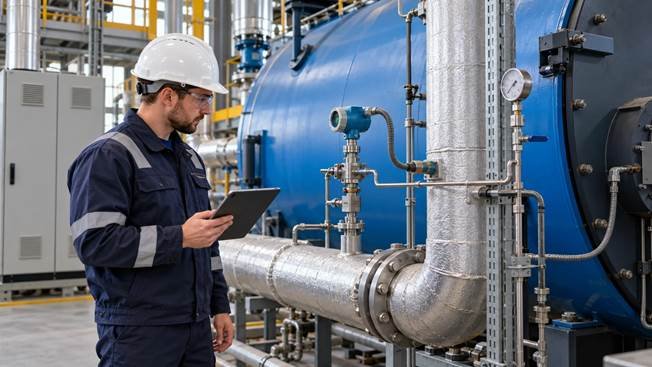
For the wider equipment context, see our introduction to AI for machines and hardware. AI is only as good as the data. Check that existing instruments are calibrated and that time stamps are consistent.
| Goal | Key measurements | Common sensor/source |
| Combustion efficiency | Flue O2, CO, stack temperature, fuel flow, combustion air flow | O2/CO analyzers, flow meters, thermocouples |
| Heat transfer and fouling | Gas-side and water-side temperatures, pressure drop | RTDs/thermocouples, pressure transmitters |
| Tube risk | Tube metal temperatures, water chemistry | Tube thermocouples, conductivity/pH analyzers |
| Pump and fan health | Vibration, motor current, temperature | Vibration sensors, VFD data |
| Demand forecasting | Steam/heat flow, ambient temperature, production schedule | Flow meters, weather feed, MES |
Example: A school boiler room with limited instrumentation may start with a small set of added sensors and wireless connectivity rather than rewiring the plant.
Common Mistake: Skipping calibration. A drifting O2 analyzer will teach the AI the wrong lessons.
Step 4: Connect the data securely
Use an edge gateway or historian that reads from the PLC, DCS or boiler controller using standard protocols such as OPC UA, Modbus or BACnet, and publishes to your analytics platform. Start with read-only access. Read-only permissions do not provide physical one-way isolation; use an engineered unidirectional gateway if that is required. Segment networks, restrict remote access and apply NIST’s OT security guidance alongside the site security program.
Expert Tip: Start read-only. You can learn a great deal and prove value without writing a single command back to the boiler.
Step 5: Build the baseline and models
Clean the data (remove bad readings, align timestamps), then build models that answer practical questions:
- What is the boiler’s expected efficiency at this load and these conditions?
- Is this behavior normal for this boiler?
- What is driving the efficiency change?
Use explainable methods where possible so operators can see why a recommendation was made. Gradient boosting with SHAP explanations is one option for tabular data; explanations show model associations rather than verified causes. Split training and validation data chronologically to reduce information leakage, and test performance across loads and fuel conditions.
Step 6: Validate in shadow mode, then advisory mode
In shadow mode, record predictions without using them to change operation. Once validated, move to advisory mode, where trained operators review recommendations before acting. Log accepted, rejected and incorrect advice. Historical comparisons alone do not prove savings: use an agreed measurement plan and account for load, fuel, weather and equipment condition.
Best Practice: Do not move on until operators trust the advice and the results beat your baseline.
Step 7: Move to limited supervised control (optional)
If your goal includes automatic optimization, allow the AI to adjust a small number of non-safety setpoints (for example, an O2 target within engineered bounds). Use management of change, hard limits in the controller, an operator override, rate-of-change limits, stale-data detection and a tested fallback to the validated conventional control strategy. Have a qualified engineer review against NFPA 85 or CSD-1 and AHJ requirements.
Step 8: Integrate with maintenance and scale
Connect alerts to your CMMS so predictions become work orders. Add boilers one at a time, retrain models after major changes, and review performance on a schedule.
Quick Checklist (Roadmap): Goal set Baseline recorded Safety and cyber review done Sensors calibrated Read-only data flowing Advisory pilot passed Control authority approved Maintenance integration ✔
AI Technologies Used in Boilers
| Technology | What it does in a boiler | Strengths | Limitations |
| Regression and gradient boosting (e.g., XGBoost) | Predicts efficiency, estimates losses | Accurate on tabular data; explainable with SHAP | Needs good historical data |
| Neural networks (ANN) | Models nonlinear combustion behavior | Handles complex relationships | Harder to explain; needs retraining |
| LSTM / GRU time-series models | Predicts behavior over time, detects gradual degradation | Good for sequences and drift | Data-hungry; tuning effort |
| Anomaly detection (statistical + ML) | Flags unusual behavior vs. learned baseline | Works without labeled failures | False alarms if baselines are weak |
| Fuzzy logic and expert systems | Encodes operator rules | Transparent; easy to validate | Limited learning ability |
| Model predictive control (MPC) / advanced process control (not inherently AI) | Optimizes setpoints within constraints | Mature in process industries | Needs modeling and commissioning |
| Reinforcement learning | Learns control policies by trial | Promising for complex combustion | Needs simulation and strong safeguards; rarely used directly on live safety-critical plant |
| Digital twin | Simulates boiler behavior for testing | Safe place to test strategies | Only as good as the underlying model |
Supporting technologies include IIoT sensors, edge gateways, data historians, OPC UA/Modbus/BACnet/MQTT connectivity, SCADA/DCS integration and CMMS/EAM software.
Expert Tip: Simple, explainable models that operators trust usually beat sophisticated ones nobody believes.
How to Choose Boiler AI Tools and Platforms
No single tool fits every site. Compare categories, then shortlist vendors. Confirm current product availability and capabilities directly with vendors, since offerings change.
| Option | Best for | Strengths | Watch-outs |
| Boiler OEM integrated controls (e.g., Cleaver-Brooks Hawk series with O2 trim, VSD and economizer options) | New builds and code-driven retrofits | OEM integration and support; verify suitability for the specific installation | Largely rule-based optimization; lock-in |
| Large automation platforms (Siemens, ABB, Emerson, Yokogawa, Schneider Electric) | Industrial and utility plants | Deep integration, enterprise support | Cost; AI modules vary by product |
| Historian and monitoring platforms (e.g., AVEVA) with AI/ML | Plants already using these systems | Data integration, root-cause analysis | Needs integration and data-science effort |
| Specialist combustion optimizers (e.g., engineered combustion optimization packages) | Combustion tuning pilots | Focus on air-fuel and emissions | Check references; mostly larger or power boilers |
| Predictive maintenance platforms (e.g., Infinite Uptime, CMMS-linked vendors) | Reliability programs | Faster to deploy; maintenance workflow | Strong on equipment health, less on combustion control; validate marketing claims |
| Open-source ML stack (Python, scikit-learn, XGBoost, PyTorch, SHAP) | In-house teams and pilots | Flexible, transparent, low license cost | Needs skills and MLOps; not safety-rated |
| Cloud AI services (AWS, Microsoft Azure, Google Cloud) | Multi-site fleets | Scalable analytics | Connectivity, data governance; check service availability |
| Residential smart controls (Vaillant, Viessmann, Worcester Bosch, tado, Hive, Nest, ecobee) | Homes and small buildings | Easy install, self-learning schedules, weather compensation | Not industrial AI; savings vary |
Quick buying criteria
- Works with your existing PLC/DCS/SCADA and historian (open protocols).
- Advisory mode first; clear control-authority limits.
- Explains its recommendations.
- Secure remote access and IEC 62443-aligned practices.
- References on boilers similar to yours.
- Clear data ownership and exit options.
Pro Tip: Ask every vendor, “Show me a customer with my boiler type, my fuel and my controls, and tell me how savings were measured.”
Implementation Process: Who Does What
| Department | Responsibility |
| Operations | Define goals, use recommendations, give feedback |
| Maintenance and reliability | Sensor upkeep, act on predictions, CMMS integration |
| Controls and automation | PLC/DCS integration, control-authority limits, management of change |
| IT / OT security | Network design, access control, patching, IEC 62443 practices |
| Data science / analytics | Models, validation, drift monitoring |
| EHS and compliance | Code compliance, AHJ and insurer liaison, emissions reporting |
| Finance and procurement | Business case, vendor contracts, savings verification |
| Energy and sustainability | KPIs, ISO 50001 alignment, reporting |
Measuring success
The US Department of Energy’s guide to boiler combustion efficiency explains why flue-gas temperature and excess air matter. AI should build on sound combustion engineering and regular maintenance.
| KPI | What it tells you | How to measure |
| Boiler efficiency (%) | Overall performance | Direct or heat-loss method, consistently applied |
| Fuel per unit of steam/heat | Cost performance | Metered fuel / metered output |
| Stack O2 and CO | Combustion quality | Calibrated analyzers |
| NOx / CO emissions | Environmental performance | Compliance monitoring |
| Unplanned downtime, trips | Reliability | Operations logs, CMMS |
| Maintenance cost | Spend efficiency | CMMS |
| Alert precision | AI usefulness | True alerts / total alerts |
| Recommendation acceptance rate | Operator trust | Advisory log |
| Payback period | Business value | Verified savings vs. total cost |
Compare against your baseline under similar load, fuel and weather. Use a consistent higher or lower heating value basis for fuel input and account for steam pressure, steam quality and feedwater enthalpy. Fuel per tonne of steam alone can mislead when these conditions change. Report meter uncertainty and avoid counting the same benefit twice.
Simple payback (years) = installed project cost / verified annual net benefit. Subtract subscriptions, support and ongoing maintenance from annual benefits before calculating payback. Do not count hypothetical avoided failures as guaranteed savings.
Cost and benefit: what to budget for
| Cost driver | Typical effect |
| Sensors and analyzers | Often the largest hardware item when instrumentation is thin |
| Controls and gateway integration | Depends on controls age and protocols |
| Software and analytics | Subscription, license or in-house build |
| Cybersecurity and network work | Required, often underestimated |
| Training and change management | Determines adoption |
| Ongoing model care | Retraining and support |
Potential benefits include lower fuel use, avoided downtime and less manual reporting. Analytics does not guarantee compliance or eliminate regulatory penalties. Request quotes and run a limited pilot to get real numbers for your site. Do not rely on generic figures.
Common Challenges and Solutions
| Challenge | Why it happens | Solution |
| Poor or missing data | Old instruments, drift, gaps | Calibrate, add sensors, start with the data you can trust |
| Legacy controls | Pneumatic, relay or closed PLC systems | Add a read-only edge layer; consider controls upgrade at a planned outage |
| Safety and code concerns | AI near combustion safety | Keep safety systems independent; engineer review; AHJ consultation |
| Cybersecurity exposure | Connected boilers expand the attack surface | Network segmentation, least privilege, one-way data first, IEC 62443 practices |
| Operator distrust | Black-box advice | Explainable models, advisory mode, involve operators early |
| Model drift | Fuel, load, equipment changes | Monitoring, scheduled retraining, change notifications |
| False alarms | Weak baselines | Tune thresholds, require persistence, review alerts weekly |
| Unclear ROI | No baseline | Measure before you start; pilot on one boiler |
| Skills gap | Boiler and data skills rarely sit in one person | Cross-functional team, trusted integrator, training |
| Vendor lock-in | Proprietary data formats | Require open protocols and data export |
As automation grows, review failure modes and ensure operators can return to a validated conventional control strategy.
Warning: If a vendor suggests AI can “replace” the burner management system, walk away.
Best Practices
- Start with one boiler and one goal.
- Run read-only, then advisory, then limited control.
- Keep a human in the loop and a clear manual override.
- Document everything under management of change.
- Involve your AHJ, insurer and boiler inspector early.
- Treat sensors and calibration as part of the AI project.
- Log AI recommendations and operator responses for learning and audits.
- Review models on a schedule and after any major equipment, fuel or process change.
- Keep data ownership and exit rights in contracts.
Best Practice: Hold a short weekly review during the pilot with operations, controls and maintenance in the same room.
Documented Boiler AI Example
Mitsubishi Hitachi Power Systems reported a combustion-tuning deployment at Taiwan Power’s Linkou plant in its 2018 project announcement. The system learned operating relationships and proposed parameters that considered boiler efficiency and auxiliary power. The supplier reported fuel-economy benefits worth up to approximately US$1 million annually for that installation.
This is a supplier-reported result from a large coal-fired power unit. It is not an independently verified savings guarantee or a forecast for a commercial packaged boiler. The transferable lesson is to define an economic objective and test recommendations against actual plant conditions.
Future Trends
- Prescriptive AI: moving from “something is wrong” to “do this next,” tied directly to maintenance workflows.
- Operator copilots: assistants that explain alarms and trends and search manuals, always as support, not control.
- Digital twins and simulation for testing strategies before they touch the live boiler.
- Reinforcement learning for combustion, mostly validated in simulation first.
- Fuel flexibility and hydrogen: research is exploring AI to manage the efficiency–NOx trade-off with new fuels.
- Hybrid heating: coordinating boilers with heat pumps and demand response.
- Stronger cybersecurity and AI governance expectations as connected boilers spread.
Implementation Checklist
| Readiness item | Ready? |
| Clear goal and success metric written down | [ ] |
| Baseline data for efficiency, fuel, trips and downtime | [ ] |
| Boiler type, fuel, controls and age documented | [ ] |
| Applicable local codes and adopted editions identified; AHJ consulted | [ ] |
| Safety systems confirmed independent of AI | [ ] |
| Key sensors installed and calibrated | [ ] |
| Open protocol access to controller or historian | [ ] |
| Network segmentation and access plan approved by IT/OT | [ ] |
| Cross-functional team and executive sponsor named | [ ] |
| Pilot scope, duration and exit criteria agreed | [ ] |
| Operator training planned | [ ] |
| Vendor questions answered, data ownership confirmed | [ ] |
Before vs. after AI enablement
| Area | Traditional | AI-enabled |
| Combustion tuning | Periodic manual tune-ups | Continuous monitoring and recommendations |
| Maintenance | Calendar-based or reactive | Condition-based and predictive |
| Alarms | Threshold alarms | Pattern-based early warnings |
| Reporting | Manual logs | Automated trends and records |
| Knowledge | Held by senior operators | Supported by documented procedures, validated patterns and operator feedback |
Frequently Asked Questions About Boiler AI
1. Do I need data scientists to enable AI in a boiler?
Not always. Many vendors provide packaged analytics, but someone on site should understand the results. In-house builds need data skills.
2. How much historical data do I need?
Enough to cover typical load, fuel and seasonal conditions. Quality matters more than volume, and event records (failures, repairs) greatly improve prediction models.
3. Can AI work with multi-fuel boilers?
Yes, but models must account for fuel type changes, so confirm the vendor has handled multi-fuel setups.
4. Will AI void my boiler warranty or insurance?
Warranty and insurance effects depend on contracts and the proposed change, even when safety logic is untouched. Obtain written clarification from the manufacturer and insurer before modifying controls, and consult the AHJ as required.
5. Is cloud or edge better?
Edge suits low-latency and connectivity-limited sites. Cloud suits fleet analytics. Many sites combine both.
6. What if the AI gives a wrong recommendation?
Operators keep authority, limits sit in the controller, and every recommendation is logged for review. This is why advisory mode comes first.
7. How often should models be retrained?
Review performance regularly and after major changes such as new burners, fuels, load patterns or sensors. Retrain when evidence justifies it, then validate the revised model before deployment.
8. Can small facilities benefit?
Yes. Starting with efficiency monitoring or a smart control can be affordable, but benefits scale with fuel spend.
9. What is the difference between predictive maintenance and combustion optimization?
Predictive maintenance forecasts equipment problems. Combustion optimization tunes how fuel and air are burned for efficiency and emissions.
10. Can generative AI run my boiler?
No. Generative assistants are useful for manuals, fault codes and reports, not control.
11. What is a good first pilot?
Read-only efficiency and anomaly monitoring on one boiler with clean data and a clear baseline.
12. How do I avoid vendor lock-in?
Insist on open protocols, data export and clear ownership of data and models.
13. Does AI help with emissions compliance?
It can support better combustion and automated records, but compliance still depends on approved monitoring and permits.
14. What skills should operators learn?
Interpreting recommendations, understanding model limits and knowing when to override.
Conclusion
Learning how to enable AI in a boiler comes down to a disciplined sequence: set a clear goal, measure a baseline, fix the data, connect securely, prove value in advisory mode, and only then give the AI limited authority, always with required safety systems standing on their own.
Done this way, AI can reduce fuel waste, give earlier warning of failures and make boiler operations easier to manage and report. Done carelessly, it adds risk and complexity. The difference is planning, safety discipline and honest measurement.
Action Plan: Your First 90 Days
| Timeframe | Actions |
| Days 1–15 | Choose one boiler and one goal. Collect baseline data. Identify governing code and notify AHJ/insurer as needed. |
| Days 16–45 | Audit sensors and controls. Calibrate key instruments. Complete a cyber review. Shortlist 2–3 vendors or an in-house approach. |
| Days 46–75 | Establish read-only data flow. Build baseline models. Review early insights with operators. |
| Days 76–90 | Start advisory pilot. Define pass/fail criteria. Prepare business case for scaling. |
Picture a plant manager on a cold January morning. Steam pressure is sagging, the boiler is burning more fuel than last winter, and the maintenance team is chasing an alarm that nobody can explain. The burner was tuned once, months ago. Since then, the fuel, weather, load, and equipment have all drifted.
This is where learning how to enable AI in a boiler pays off. Boilers generate a steady stream of data (temperatures, pressures, flows, flue gas oxygen, and pump vibration), and most of it goes unanalyzed. AI can turn that data into early warnings, tuning recommendations, and measurable fuel and reliability gains.
AI is a decision-support and optimization layer. Its value depends on reliable measurements, appropriate models, and disciplined operator review; it must not replace required boiler protection.
This guide shows you exactly how to do it: where AI fits, what to install, who to involve, what can go wrong, and how to prove it worked. It is written mainly for industrial and commercial boilers (steam and hot water plants), with a short section for homeowners at the end of the “Where” section.
Quick Answer: How to Enable AI in a Boiler
To enable AI in a boiler, define a goal such as efficiency or fewer failures, baseline current performance, add and calibrate sensors, connect boiler data securely through your PLC or DCS to an analytics platform, run the AI in advisory mode first, then allow limited supervisory control while certified burner and safety controls remain independent.
Key Takeaway: AI advises and optimizes. Your flame safeguard, low-water cutoff and pressure limits keep protecting the boiler on their own.
What Is AI Enablement in a Boiler?
AI enablement in a boiler means giving the boiler system the data, connectivity and software it needs so machine learning models can analyze performance and support decisions. In practice it covers four layers:
- Sensing: instruments that measure what is happening (flue gas O2 and CO, stack temperature, pressures, flows, levels, water chemistry, vibration).
- Connectivity: a secure path from the boiler controller (PLC, DCS, burner management system) to a data platform.
- Intelligence: models that learn normal behavior, estimate efficiency, flag anomalies and predict wear.
- Action: recommendations to operators, work orders in the maintenance system, and, only when validated, limited automatic setpoint adjustment.
Boiler analytics can combine regression, neural networks, statistical monitoring and engineering models. The appropriate method depends on the use case, available measurements and ability to validate its recommendations.
Boiler AI is not the same as “smart thermostat” AI. Industrial AI optimizes combustion and predicts equipment faults. Residential “smart boiler” features (self-learning schedules, weather compensation, app control) are simpler. Both are covered below, but the roadmap focuses on plants and buildings.
Common Mistake: Treating a chatbot or manual-lookup assistant as “AI in the boiler.” Those tools help technicians find fault codes. They do not optimize or protect the boiler.
Why Enable AI in a Boiler?
Conventional boiler control works well on average, but boilers rarely run on average. Fuel quality, ambient temperature, steam demand, fouling and equipment wear all shift. Manual tuning captures one moment in time.
AI helps because it:
- Watches continuously, not only during the annual tune-up.
- Sees combinations of variables a human cannot track at once (load, O2, stack temperature, feedwater temperature, ambient conditions).
- Detects slow drift such as fouling or air leaks before it shows up as an alarm.
- Supports knowledge transfer, when validated operating patterns are documented alongside experienced operators’ explanations.
When should you do it? The best triggers are rising fuel cost, repeated unplanned trips, an upcoming controls upgrade, emissions or ISO 50001 targets, or an ageing boiler where failure would be costly.
Expert Tip: Pick the problem first (fuel, reliability or emissions), then the technology. Projects that start with “let’s use AI” tend to stall.
Benefits of Enabling AI in a Boiler
| Benefit | How AI delivers it | Evidence level |
| Lower fuel use | Continuously tunes air-fuel ratio targets and spots efficiency loss early | Demonstrated in utility trials (MHPS at Taiwan Power’s Linkou plant); exact savings vary by site |
| Fewer unplanned failures | Anomaly detection and failure prediction on tubes, pumps, fans | Depends on instrumentation, failure history and follow-through |
| Lower emissions | Optimization can balance efficiency, CO and NOx within operating constraints; these objectives can conflict | Requires site testing and approved emissions measurements |
| Better audit trail | Automatic logging of conditions and maintenance actions | Common feature of monitoring platforms |
| Operator support | Explains why efficiency changed (e.g., SHAP-based explanations) | Model explanations indicate associations, not proven physical causes |
| Smarter planning | Forecasts steam or heat demand to stage multiple boilers | Established in sequencing and forecasting practice |
Warning: Be careful with percentage claims on vendor websites. Ask for a baseline, a test method and a reference site before you trust any savings number. Your own pilot is the only number that matters.
Where AI Can Be Implemented in a Boiler System
| Area | Typical AI use | Data needed | Difficulty |
| Combustion | Excess air and O2 trim optimization, burner drift detection | Flue O2/CO, stack temp, fuel flow, air flow, load | Medium to high |
| Efficiency monitoring | Real-time efficiency estimate, loss attribution | Steam/hot water output, fuel input, stack data | Low to medium |
| Tubes and heat transfer | Fouling, scaling and slagging detection; tube failure risk | Tube metal temps, gas path temps, water chemistry | Medium to high |
| Feedwater and drum level | Anomaly detection, pump health | Level, flow, pressure, pump vibration | Medium |
| Water chemistry | Early warning on scale and corrosion risk | pH, conductivity, dissolved oxygen | Low to medium |
| Multi-boiler plants | Sequencing and load allocation | Demand history, boiler curves | Medium |
| Maintenance | Predictive work orders, remaining useful life where supported by suitable failure data | Sensor history, maintenance logs | Medium |
| Reporting and compliance | Automated logs and trend reports | Controller and inspection records | Low |
Residential and small-building boilers (short version)
Homeowners and small-building owners may benefit from compatible connected controls, scheduling and weather compensation. These features are not necessarily machine learning. Check the boiler manufacturer’s compatibility requirements: OpenTherm and proprietary modulation protocols are not interchangeable, and some controllers provide only on/off switching. Have a qualified heating professional assess the installation. For building-level integration, see our guide to AI in an HVAC system.
Pro Tip: If you only have a basic on/off boiler, check compatibility (OpenTherm or manufacturer-specific) before buying a “smart” controller.
How to Enable AI in a Boiler: An 8-Step Roadmap
This is the core of the guide. Timelines are planning ranges, not guarantees. Your boiler type, controls age and approvals will change them.
| Phase | What happens | Owner | Typical duration |
| 0. Define | Pick the use case and success metrics | Plant/energy manager | 2–4 weeks |
| 1. Assess | Controls inventory, sensor gaps, code and cyber review | Controls engineer, EHS, IT/OT | 2–6 weeks |
| 2. Instrument | Add or calibrate sensors | Instrumentation team | 2–8 weeks |
| 3. Connect | Secure data path to historian/edge | Controls + IT/OT security | 2–6 weeks |
| 4. Model | Clean data, build baseline and models | Data scientist + boiler engineer | 4–12 weeks |
| 5. Advisory pilot | AI recommends, operators decide | Operations | 1–3 months |
| 6. Supervised control | Limited-authority setpoint changes | Controls + operations | 1–3 months |
| 7. Scale | More boilers, CMMS integration, retraining | Program owner | Ongoing |
Step 1: Define the goal and baseline
Choose one primary goal: lower fuel use, fewer failures, lower emissions or better reporting. Then record baseline numbers over a period that represents relevant loads and operating conditions; use a full season where weather materially affects demand: fuel consumed per unit of steam or heat, stack O2, trips, downtime hours, maintenance cost.
Example: A food plant picks “reduce unplanned boiler trips” as the goal because trips stop production. Baseline: trips and downtime hours over the last 12 months.
Best Practice: Write the success metric in one sentence before buying anything.
Step 2: Assess your boiler, controls and constraints
Document the boiler type (firetube or watertube), fuels, burner and controls make and age, and what is already measured. Identify the locally adopted boiler, electrical, pressure equipment and combustion requirements. In the United States, ASME CSD-1 covers specified automatically operated boilers with fuel input ratings under 12,500,000 Btu/hr. NFPA 85 may apply to other combustion systems, depending on equipment and scope. Capacity alone does not establish every applicable requirement. A qualified engineer and the authority having jurisdiction (AHJ) should confirm the applicable editions, exclusions and approvals. Other countries have their own requirements.
Also assess cybersecurity: who can reach the boiler network, and how.
Warning: Do not connect an uncertified AI system to burner safety logic. Keep flame safeguard, low-water cutoffs and pressure limits independent and compliant with applicable requirements.
Step 3: Close the sensor and data gaps
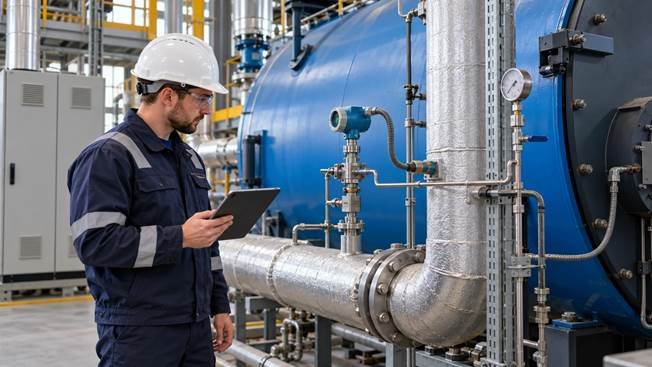
For the wider equipment context, see our introduction to AI for machines and hardware. AI is only as good as the data. Check that existing instruments are calibrated and that time stamps are consistent.
| Goal | Key measurements | Common sensor/source |
| Combustion efficiency | Flue O2, CO, stack temperature, fuel flow, combustion air flow | O2/CO analyzers, flow meters, thermocouples |
| Heat transfer and fouling | Gas-side and water-side temperatures, pressure drop | RTDs/thermocouples, pressure transmitters |
| Tube risk | Tube metal temperatures, water chemistry | Tube thermocouples, conductivity/pH analyzers |
| Pump and fan health | Vibration, motor current, temperature | Vibration sensors, VFD data |
| Demand forecasting | Steam/heat flow, ambient temperature, production schedule | Flow meters, weather feed, MES |
Example: A school boiler room with limited instrumentation may start with a small set of added sensors and wireless connectivity rather than rewiring the plant.
Common Mistake: Skipping calibration. A drifting O2 analyzer will teach the AI the wrong lessons.
Step 4: Connect the data securely
Use an edge gateway or historian that reads from the PLC, DCS or boiler controller using standard protocols such as OPC UA, Modbus or BACnet, and publishes to your analytics platform. Start with read-only access. Read-only permissions do not provide physical one-way isolation; use an engineered unidirectional gateway if that is required. Segment networks, restrict remote access and apply NIST’s OT security guidance alongside the site security program.
Expert Tip: Start read-only. You can learn a great deal and prove value without writing a single command back to the boiler.
Step 5: Build the baseline and models
Clean the data (remove bad readings, align timestamps), then build models that answer practical questions:
- What is the boiler’s expected efficiency at this load and these conditions?
- Is this behavior normal for this boiler?
- What is driving the efficiency change?
Use explainable methods where possible so operators can see why a recommendation was made. Gradient boosting with SHAP explanations is one option for tabular data; explanations show model associations rather than verified causes. Split training and validation data chronologically to reduce information leakage, and test performance across loads and fuel conditions.
Step 6: Validate in shadow mode, then advisory mode
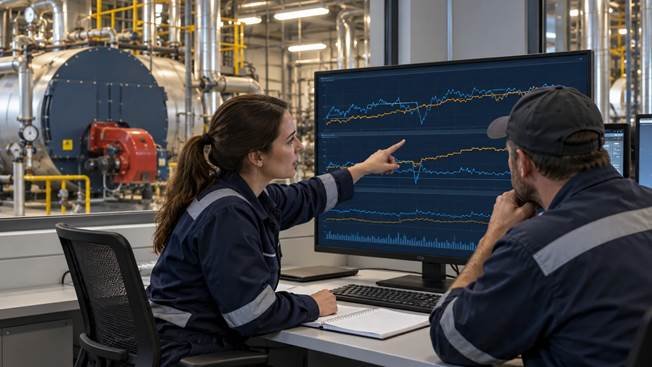
In shadow mode, record predictions without using them to change operation. Once validated, move to advisory mode, where trained operators review recommendations before acting. Log accepted, rejected and incorrect advice. Historical comparisons alone do not prove savings: use an agreed measurement plan and account for load, fuel, weather and equipment condition.
Best Practice: Do not move on until operators trust the advice and the results beat your baseline.
Step 7: Move to limited supervised control (optional)
If your goal includes automatic optimization, allow the AI to adjust a small number of non-safety setpoints (for example, an O2 target within engineered bounds). Use management of change, hard limits in the controller, an operator override, rate-of-change limits, stale-data detection and a tested fallback to the validated conventional control strategy. Have a qualified engineer review against NFPA 85 or CSD-1 and AHJ requirements.
Step 8: Integrate with maintenance and scale
Connect alerts to your CMMS so predictions become work orders. Add boilers one at a time, retrain models after major changes, and review performance on a schedule.
Quick Checklist (Roadmap): Goal set Baseline recorded Safety and cyber review done Sensors calibrated Read-only data flowing Advisory pilot passed Control authority approved Maintenance integration ✔
AI Technologies Used in Boilers
| Technology | What it does in a boiler | Strengths | Limitations |
| Regression and gradient boosting (e.g., XGBoost) | Predicts efficiency, estimates losses | Accurate on tabular data; explainable with SHAP | Needs good historical data |
| Neural networks (ANN) | Models nonlinear combustion behavior | Handles complex relationships | Harder to explain; needs retraining |
| LSTM / GRU time-series models | Predicts behavior over time, detects gradual degradation | Good for sequences and drift | Data-hungry; tuning effort |
| Anomaly detection (statistical + ML) | Flags unusual behavior vs. learned baseline | Works without labeled failures | False alarms if baselines are weak |
| Fuzzy logic and expert systems | Encodes operator rules | Transparent; easy to validate | Limited learning ability |
| Model predictive control (MPC) / advanced process control (not inherently AI) | Optimizes setpoints within constraints | Mature in process industries | Needs modeling and commissioning |
| Reinforcement learning | Learns control policies by trial | Promising for complex combustion | Needs simulation and strong safeguards; rarely used directly on live safety-critical plant |
| Digital twin | Simulates boiler behavior for testing | Safe place to test strategies | Only as good as the underlying model |
Supporting technologies include IIoT sensors, edge gateways, data historians, OPC UA/Modbus/BACnet/MQTT connectivity, SCADA/DCS integration and CMMS/EAM software.
Expert Tip: Simple, explainable models that operators trust usually beat sophisticated ones nobody believes.
How to Choose Boiler AI Tools and Platforms
No single tool fits every site. Compare categories, then shortlist vendors. Confirm current product availability and capabilities directly with vendors, since offerings change.
| Option | Best for | Strengths | Watch-outs |
| Boiler OEM integrated controls (e.g., Cleaver-Brooks Hawk series with O2 trim, VSD and economizer options) | New builds and code-driven retrofits | OEM integration and support; verify suitability for the specific installation | Largely rule-based optimization; lock-in |
| Large automation platforms (Siemens, ABB, Emerson, Yokogawa, Schneider Electric) | Industrial and utility plants | Deep integration, enterprise support | Cost; AI modules vary by product |
| Historian and monitoring platforms (e.g., AVEVA) with AI/ML | Plants already using these systems | Data integration, root-cause analysis | Needs integration and data-science effort |
| Specialist combustion optimizers (e.g., engineered combustion optimization packages) | Combustion tuning pilots | Focus on air-fuel and emissions | Check references; mostly larger or power boilers |
| Predictive maintenance platforms (e.g., Infinite Uptime, CMMS-linked vendors) | Reliability programs | Faster to deploy; maintenance workflow | Strong on equipment health, less on combustion control; validate marketing claims |
| Open-source ML stack (Python, scikit-learn, XGBoost, PyTorch, SHAP) | In-house teams and pilots | Flexible, transparent, low license cost | Needs skills and MLOps; not safety-rated |
| Cloud AI services (AWS, Microsoft Azure, Google Cloud) | Multi-site fleets | Scalable analytics | Connectivity, data governance; check service availability |
| Residential smart controls (Vaillant, Viessmann, Worcester Bosch, tado, Hive, Nest, ecobee) | Homes and small buildings | Easy install, self-learning schedules, weather compensation | Not industrial AI; savings vary |
Quick buying criteria
- Works with your existing PLC/DCS/SCADA and historian (open protocols).
- Advisory mode first; clear control-authority limits.
- Explains its recommendations.
- Secure remote access and IEC 62443-aligned practices.
- References on boilers similar to yours.
- Clear data ownership and exit options.
Pro Tip: Ask every vendor, “Show me a customer with my boiler type, my fuel and my controls, and tell me how savings were measured.”
Implementation Process: Who Does What
| Department | Responsibility |
| Operations | Define goals, use recommendations, give feedback |
| Maintenance and reliability | Sensor upkeep, act on predictions, CMMS integration |
| Controls and automation | PLC/DCS integration, control-authority limits, management of change |
| IT / OT security | Network design, access control, patching, IEC 62443 practices |
| Data science / analytics | Models, validation, drift monitoring |
| EHS and compliance | Code compliance, AHJ and insurer liaison, emissions reporting |
| Finance and procurement | Business case, vendor contracts, savings verification |
| Energy and sustainability | KPIs, ISO 50001 alignment, reporting |
Measuring success
The US Department of Energy’s guide to boiler combustion efficiency explains why flue-gas temperature and excess air matter. AI should build on sound combustion engineering and regular maintenance.
| KPI | What it tells you | How to measure |
| Boiler efficiency (%) | Overall performance | Direct or heat-loss method, consistently applied |
| Fuel per unit of steam/heat | Cost performance | Metered fuel / metered output |
| Stack O2 and CO | Combustion quality | Calibrated analyzers |
| NOx / CO emissions | Environmental performance | Compliance monitoring |
| Unplanned downtime, trips | Reliability | Operations logs, CMMS |
| Maintenance cost | Spend efficiency | CMMS |
| Alert precision | AI usefulness | True alerts / total alerts |
| Recommendation acceptance rate | Operator trust | Advisory log |
| Payback period | Business value | Verified savings vs. total cost |
Compare against your baseline under similar load, fuel and weather. Use a consistent higher or lower heating value basis for fuel input and account for steam pressure, steam quality and feedwater enthalpy. Fuel per tonne of steam alone can mislead when these conditions change. Report meter uncertainty and avoid counting the same benefit twice.
Simple payback (years) = installed project cost / verified annual net benefit. Subtract subscriptions, support and ongoing maintenance from annual benefits before calculating payback. Do not count hypothetical avoided failures as guaranteed savings.
Cost and benefit: what to budget for
| Cost driver | Typical effect |
| Sensors and analyzers | Often the largest hardware item when instrumentation is thin |
| Controls and gateway integration | Depends on controls age and protocols |
| Software and analytics | Subscription, license or in-house build |
| Cybersecurity and network work | Required, often underestimated |
| Training and change management | Determines adoption |
| Ongoing model care | Retraining and support |
Potential benefits include lower fuel use, avoided downtime and less manual reporting. Analytics does not guarantee compliance or eliminate regulatory penalties. Request quotes and run a limited pilot to get real numbers for your site. Do not rely on generic figures.
Common Challenges and Solutions
| Challenge | Why it happens | Solution |
| Poor or missing data | Old instruments, drift, gaps | Calibrate, add sensors, start with the data you can trust |
| Legacy controls | Pneumatic, relay or closed PLC systems | Add a read-only edge layer; consider controls upgrade at a planned outage |
| Safety and code concerns | AI near combustion safety | Keep safety systems independent; engineer review; AHJ consultation |
| Cybersecurity exposure | Connected boilers expand the attack surface | Network segmentation, least privilege, one-way data first, IEC 62443 practices |
| Operator distrust | Black-box advice | Explainable models, advisory mode, involve operators early |
| Model drift | Fuel, load, equipment changes | Monitoring, scheduled retraining, change notifications |
| False alarms | Weak baselines | Tune thresholds, require persistence, review alerts weekly |
| Unclear ROI | No baseline | Measure before you start; pilot on one boiler |
| Skills gap | Boiler and data skills rarely sit in one person | Cross-functional team, trusted integrator, training |
| Vendor lock-in | Proprietary data formats | Require open protocols and data export |
As automation grows, review failure modes and ensure operators can return to a validated conventional control strategy.
Warning: If a vendor suggests AI can “replace” the burner management system, walk away.
Best Practices
- Start with one boiler and one goal.
- Run read-only, then advisory, then limited control.
- Keep a human in the loop and a clear manual override.
- Document everything under management of change.
- Involve your AHJ, insurer and boiler inspector early.
- Treat sensors and calibration as part of the AI project.
- Log AI recommendations and operator responses for learning and audits.
- Review models on a schedule and after any major equipment, fuel or process change.
- Keep data ownership and exit rights in contracts.
Best Practice: Hold a short weekly review during the pilot with operations, controls and maintenance in the same room.
Documented Boiler AI Example
Mitsubishi Hitachi Power Systems reported a combustion-tuning deployment at Taiwan Power’s Linkou plant in its 2018 project announcement. The system learned operating relationships and proposed parameters that considered boiler efficiency and auxiliary power. The supplier reported fuel-economy benefits worth up to approximately US$1 million annually for that installation.
This is a supplier-reported result from a large coal-fired power unit. It is not an independently verified savings guarantee or a forecast for a commercial packaged boiler. The transferable lesson is to define an economic objective and test recommendations against actual plant conditions.
Future Trends
- Prescriptive AI: moving from “something is wrong” to “do this next,” tied directly to maintenance workflows.
- Operator copilots: assistants that explain alarms and trends and search manuals, always as support, not control.
- Digital twins and simulation for testing strategies before they touch the live boiler.
- Reinforcement learning for combustion, mostly validated in simulation first.
- Fuel flexibility and hydrogen: research is exploring AI to manage the efficiency–NOx trade-off with new fuels.
- Hybrid heating: coordinating boilers with heat pumps and demand response.
- Stronger cybersecurity and AI governance expectations as connected boilers spread.
Implementation Checklist
| Readiness item | Ready? |
| Clear goal and success metric written down | |
| Baseline data for efficiency, fuel, trips and downtime | |
| Boiler type, fuel, controls and age documented | |
| Applicable local codes and adopted editions identified; AHJ consulted | |
| Safety systems confirmed independent of AI | |
| Key sensors installed and calibrated | |
| Open protocol access to controller or historian | |
| Network segmentation and access plan approved by IT/OT | |
| Cross-functional team and executive sponsor named | |
| Pilot scope, duration and exit criteria agreed | |
| Operator training planned | |
| Vendor questions answered, data ownership confirmed |
Before vs. after AI enablement
| Area | Traditional | AI-enabled |
| Combustion tuning | Periodic manual tune-ups | Continuous monitoring and recommendations |
| Maintenance | Calendar-based or reactive | Condition-based and predictive |
| Alarms | Threshold alarms | Pattern-based early warnings |
| Reporting | Manual logs | Automated trends and records |
| Knowledge | Held by senior operators | Supported by documented procedures, validated patterns and operator feedback |
Frequently Asked Questions About Boiler AI
1. Do I need data scientists to enable AI in a boiler?
Not always. Many vendors provide packaged analytics, but someone on site should understand the results. In-house builds need data skills.
2. How much historical data do I need?
Enough to cover typical load, fuel and seasonal conditions. Quality matters more than volume, and event records (failures, repairs) greatly improve prediction models.
3. Can AI work with multi-fuel boilers?
Yes, but models must account for fuel type changes, so confirm the vendor has handled multi-fuel setups.
4. Will AI void my boiler warranty or insurance?
Warranty and insurance effects depend on contracts and the proposed change, even when safety logic is untouched. Obtain written clarification from the manufacturer and insurer before modifying controls, and consult the AHJ as required.
5. Is cloud or edge better?
Edge suits low-latency and connectivity-limited sites. Cloud suits fleet analytics. Many sites combine both.
6. What if the AI gives a wrong recommendation?
Operators keep authority, limits sit in the controller, and every recommendation is logged for review. This is why advisory mode comes first.
7. How often should models be retrained?
Review performance regularly and after major changes such as new burners, fuels, load patterns or sensors. Retrain when evidence justifies it, then validate the revised model before deployment.
8. Can small facilities benefit?
Yes. Starting with efficiency monitoring or a smart control can be affordable, but benefits scale with fuel spend.
9. What is the difference between predictive maintenance and combustion optimization?
Predictive maintenance forecasts equipment problems. Combustion optimization tunes how fuel and air are burned for efficiency and emissions.
10. Can generative AI run my boiler?
No. Generative assistants are useful for manuals, fault codes and reports, not control.
11. What is a good first pilot?
Read-only efficiency and anomaly monitoring on one boiler with clean data and a clear baseline.
12. How do I avoid vendor lock-in?
Insist on open protocols, data export and clear ownership of data and models.
13. Does AI help with emissions compliance?
It can support better combustion and automated records, but compliance still depends on approved monitoring and permits.
14. What skills should operators learn?
Interpreting recommendations, understanding model limits and knowing when to override.
Conclusion
Learning how to enable AI in a boiler comes down to a disciplined sequence: set a clear goal, measure a baseline, fix the data, connect securely, prove value in advisory mode, and only then give the AI limited authority, always with required safety systems standing on their own.
Done this way, AI can reduce fuel waste, give earlier warning of failures and make boiler operations easier to manage and report. Done carelessly, it adds risk and complexity. The difference is planning, safety discipline and honest measurement.
Action Plan: Your First 90 Days
| Timeframe | Actions |
| Days 1–15 | Choose one boiler and one goal. Collect baseline data. Identify governing code and notify AHJ/insurer as needed. |
| Days 16–45 | Audit sensors and controls. Calibrate key instruments. Complete a cyber review. Shortlist 2–3 vendors or an in-house approach. |
| Days 46–75 | Establish read-only data flow. Build baseline models. Review early insights with operators. |
| Days 76–90 | Start advisory pilot. Define pass/fail criteria. Prepare business case for scaling. |